Plateau Mountain - High Peak #1
In the introduction to The Catskill Forest: a History, Dr. Michael Kudish writes:
I view the Catskills from the summits down, observing people swarming up the valleys, chaotically creating disturbances at the lowest elevations to the greatest degree and at the highest elevations to the least degree. Some of the more remote and less accessible summits have escaped human disturbance to this day except for an occasional hiker or hunter. To me, the summits are the norm, the comprehensible, the familiar, the simple. The valleys are foreign, mysterious, complex, threatening, and confounding.
This statement resonates with us profoundly. Kudish isn’t just acknowledging the gradient of human impact from the mountain tops to the deeply altered lowlands. He is situating the reader in an understanding of the world that does not privilege humans. Here, forest ecosystems where human beings have not successfully exerted dominance are to be considered “the norm, the comprehensible.” This is a complete departure from the way we are conditioned to look at nature. The words Kudish uses to describe settled lands are more familiar to us as descriptions of wilderness: “foreign, mysterious [and] threatening.”
Kudish proposes a novel way of interpreting our landscape. What if we discard the assumption that humans are more valuable, powerful, and meaningful than other beings? What if we, instead, observe the forest on its own terms? This is an approach we have been trying to articulate for some time. Kudish makes it self-evident in his earnest, direct statement on Catskill mountain summits.
Our research has primarily occurred in chaotic, repeatedly disturbed forests. These are nonetheless beautiful, important places where the loss and resilience of tree species can be seen up close. They have enormous relevance because they are relatable and extremely common; these are our backyard forests, the trees lining our highways and parking lots, rail trails and public parks. Our essential goal as Processing Collapse is to identify entry points for all kinds of people to notice the ecosystem surrounding them.
But how do forests operate when their autonomy is respected? How do the familiar Catskills forests change as we ascend to the less-touched mountain summits? We decided it was time to begin learning from the high peaks.
This entry will be the first in a series of Catskills summit hike journals. This collaborative writing is derived from our individual field notes and impressions; you will read our misidentifications, gaps in knowledge, and small moments of reverie unfiltered. Later discoveries or clarifications will be added in italics.
May 21, 2026
Plateau Mountain (‘3840)
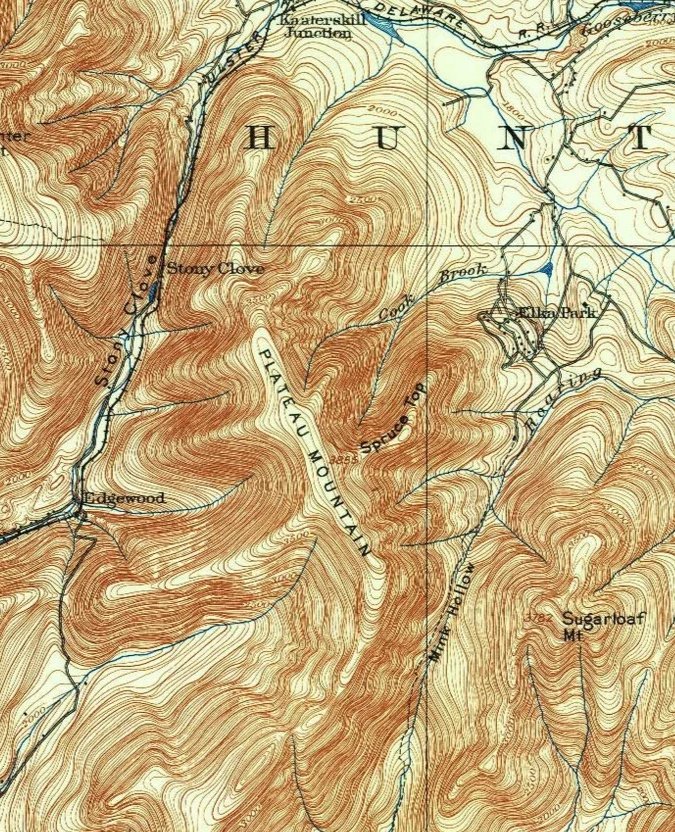
We parked on the Elka Park side of Mink Hollow for a walk to Plateau (and potentially Sugar Loaf) mountain. We had already scouted the hike into the notch the week before. It was less than a mile and not terribly steep. The trailhead begins at a relatively high elevation, so the gap is quite accessible from this spot. On our first visit into the notch we discovered ramps. I (Michael) had been looking for them for so long!!! We harvested some and grilled them up outside the studio later that day. So delicious. We also tried a few casts with a tenkara rod on the small stream that runs the first half mile of the approach. We couldn’t catch anything but had discovered trout in that stream the previous year.
When we reached the gap today, we opted to climb Plateau. Either direction would lead us to the top of a Catskill peak over 3500 feet in elevation. The gain would be 1200 feet in about a mile.
Michael had been up Sugarloaf years before, so it seemed fun to try something new. As we climbed, we watched for ramps. There were other plants that had a similar look. Little by little we were able to see the difference between the ramps and what PlantNet describes as a blue-bead lily.
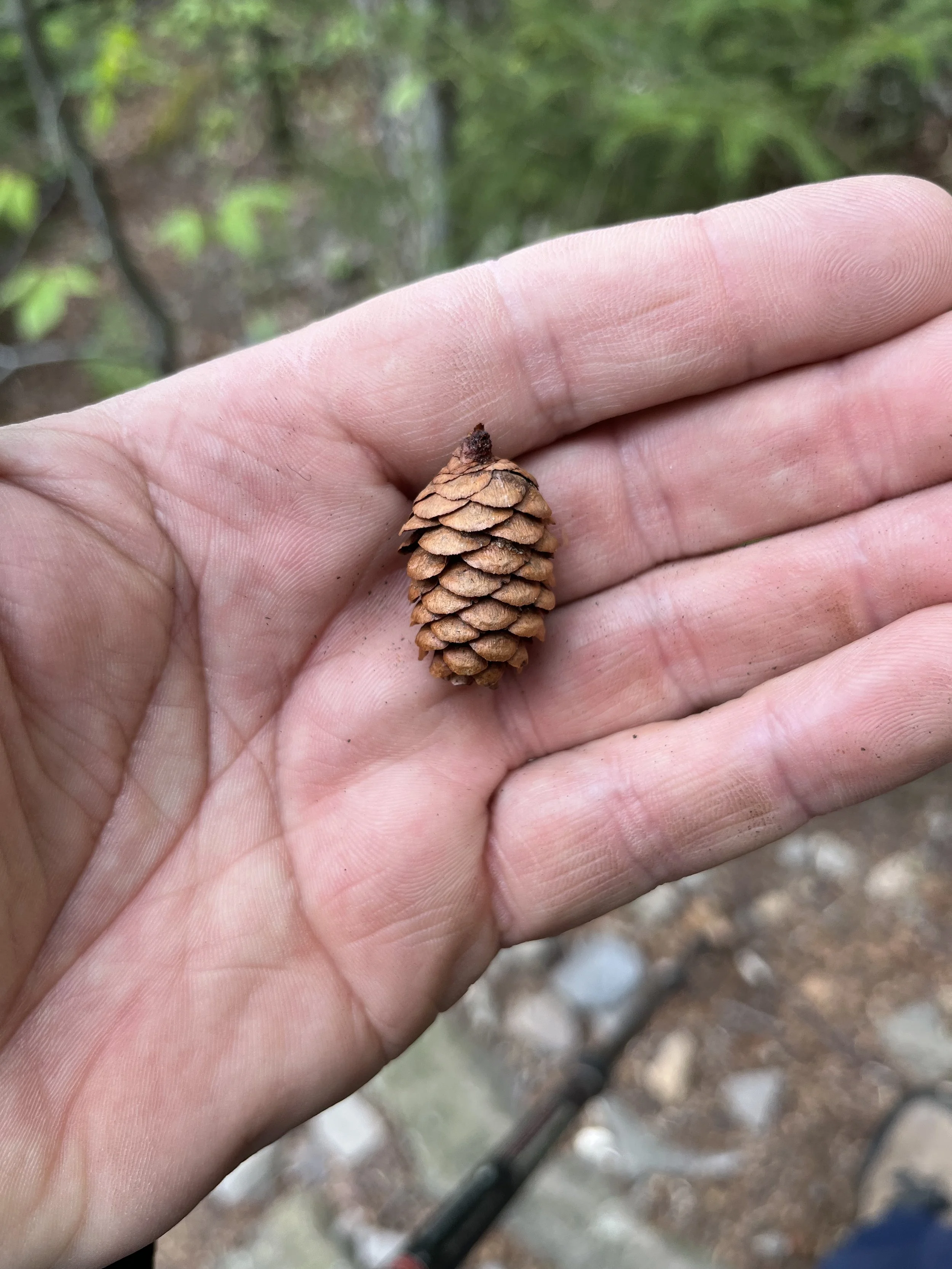
We climbed into a dense conifer woods. Initially we thought we were seeing spruce, but the needle configuration was confusing. Now we’re thinking it could be fir–balsam fir? The needles are pointy. The branches don’t droop. Cones are small, but at least 50% larger than hemlock.
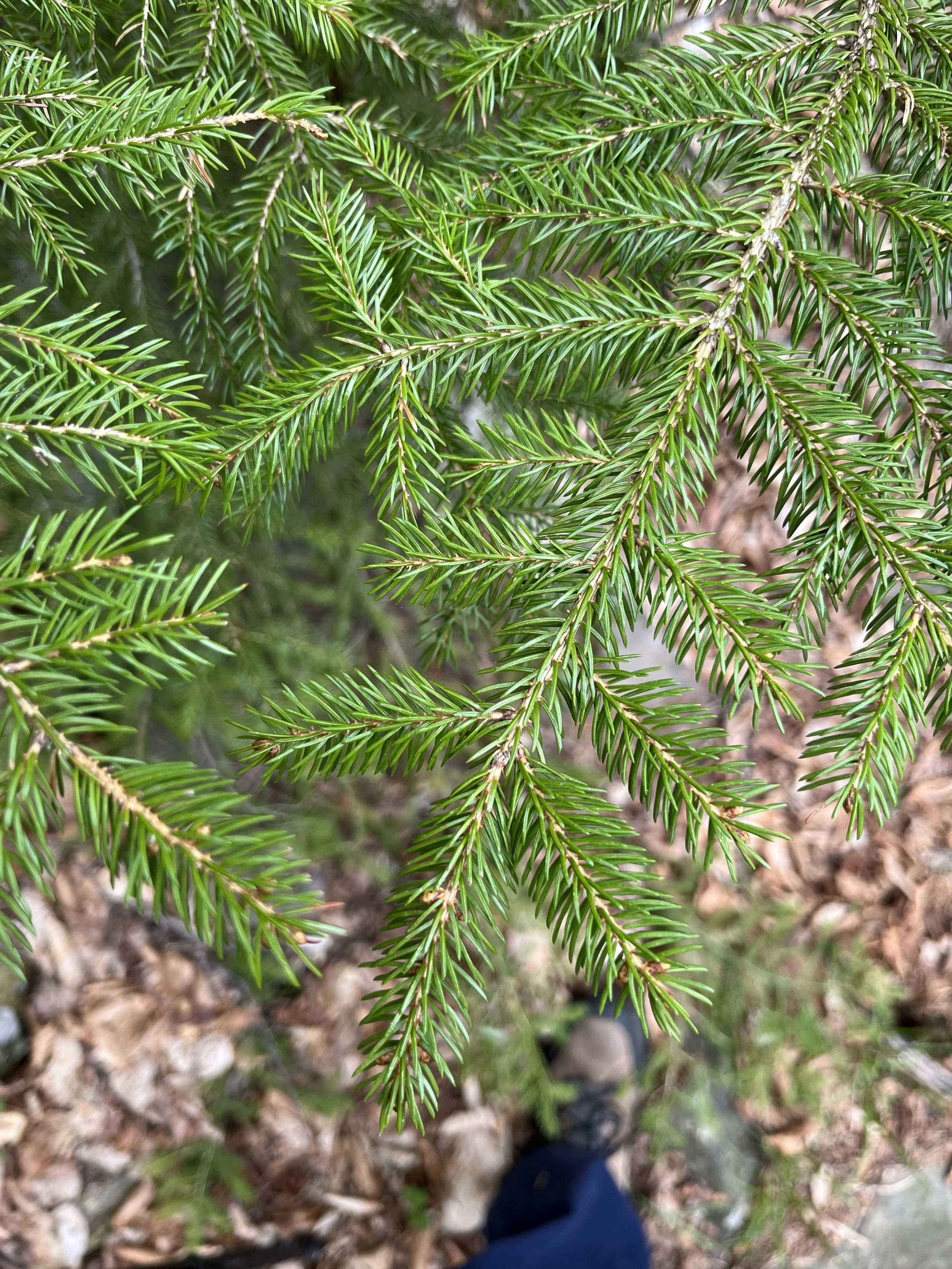
Our initial instincts weren’t far off.
We were surrounded by red spruce (Picea rubens) as we made the steep ascent.
During the last climb and up on the summit, we began to see “hemlocks” that were really strange. The needles are uncharacteristically dense, thick, and lush, but they have two stomata stripes like Eastern hemlock. Michael’s hunch is that they could be healthy and unafflicted by HWA, making them quite different than what we’ve learned to see. I (Ripley) am stuck on how rigid and thick the boughs and branches are–not at all feathery as hemlock is historically described and typically seen. The bark is entirely new to me. The plates (if they can be called plates) are small, reddish and quite thin. Not thick, furrowed, layered or brown. I can’t quite believe this is hemlock. And if it is, I have to speculate that this is a different variety or adaptation, perhaps endemic to high peaks.
We later found out that these trees were balsam fir (Abies balsamea).
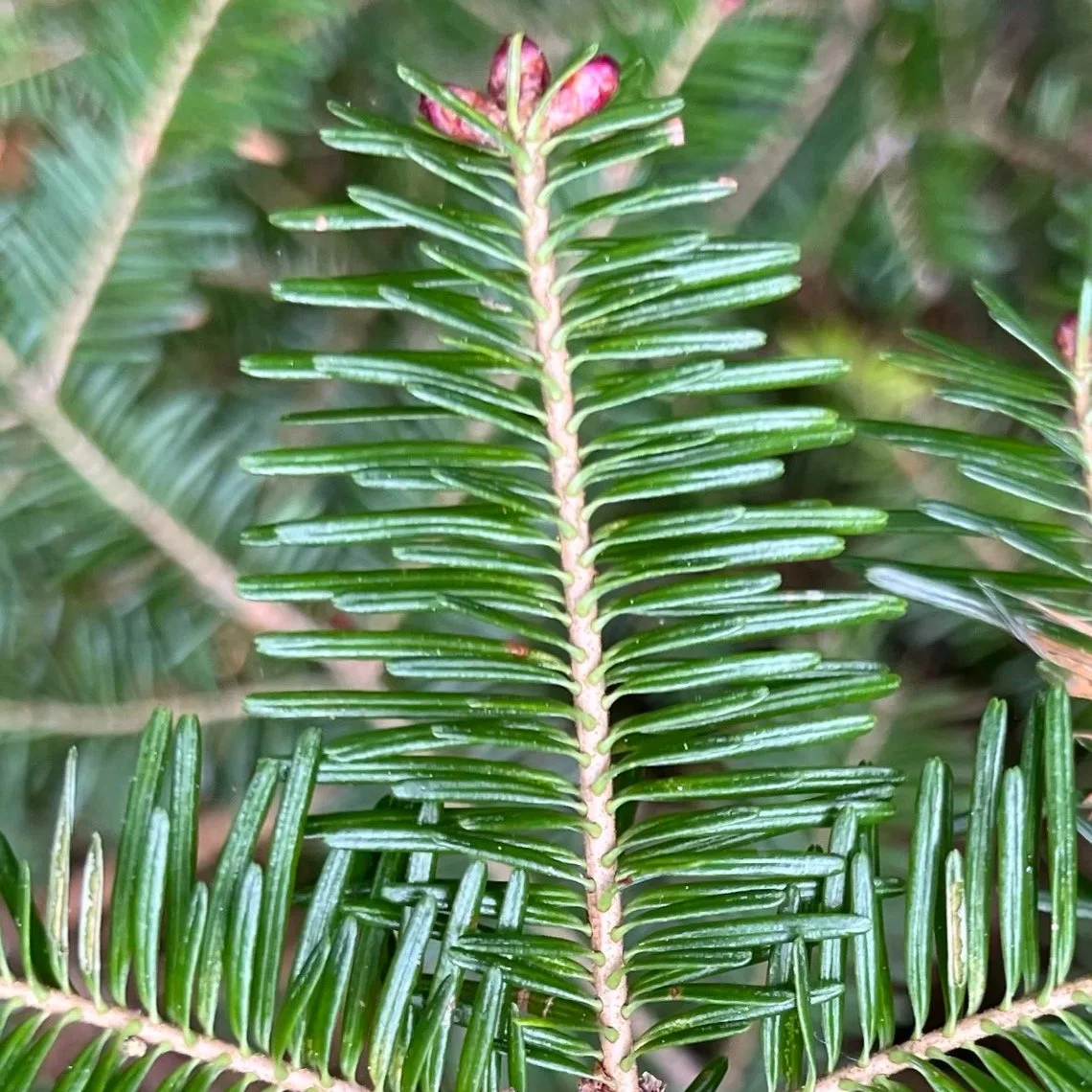
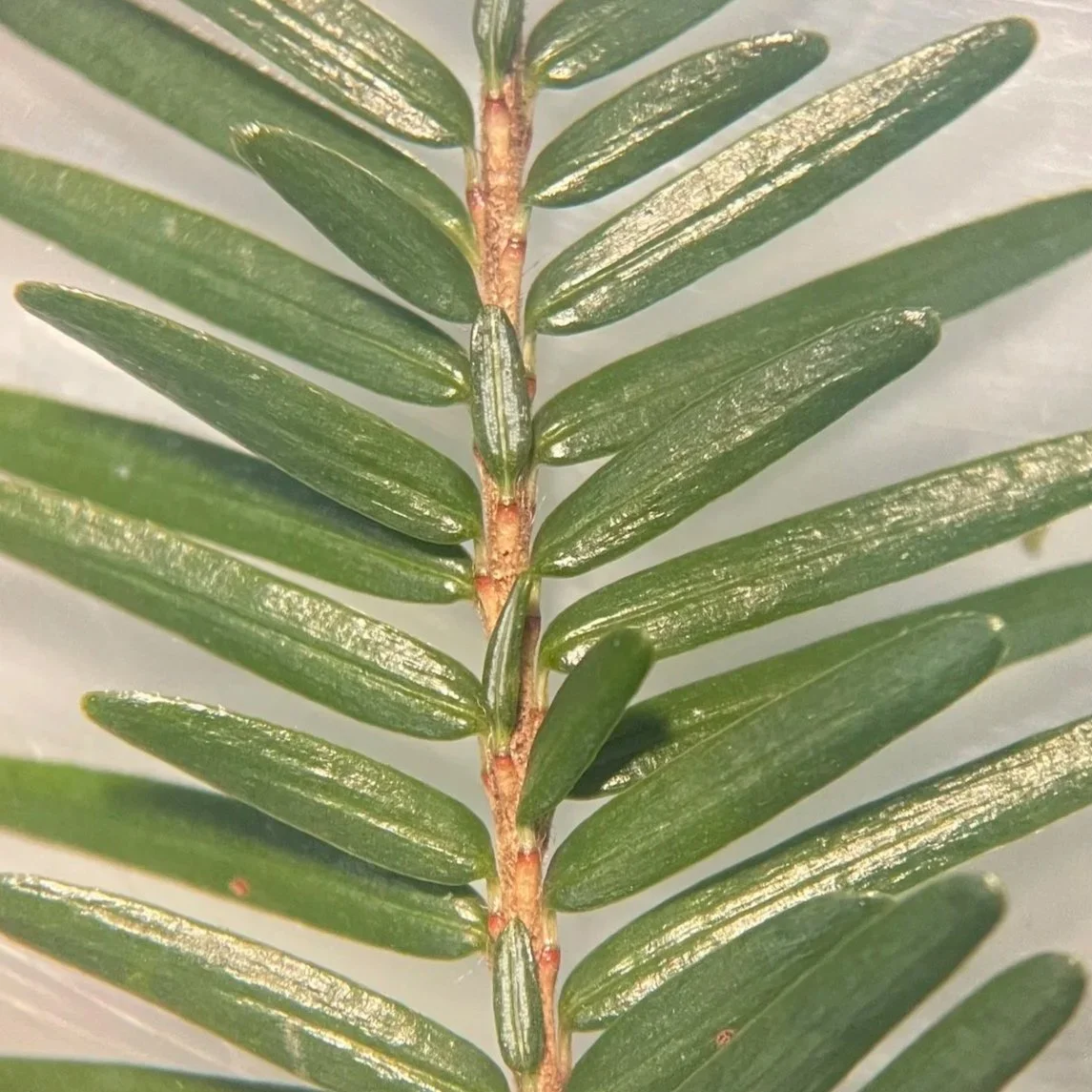
The most telling difference for us is at the junction of needle and bough. Balsam fir needles (left) come directly off the stem, while hemlock needles (right) emerge on little pegs from bulbous growth nodes.
Also, Eastern hemlock does not typically grow above 3,000 ft elevation. This tree will not appear as consistently on our peak hikes as on our other walks.
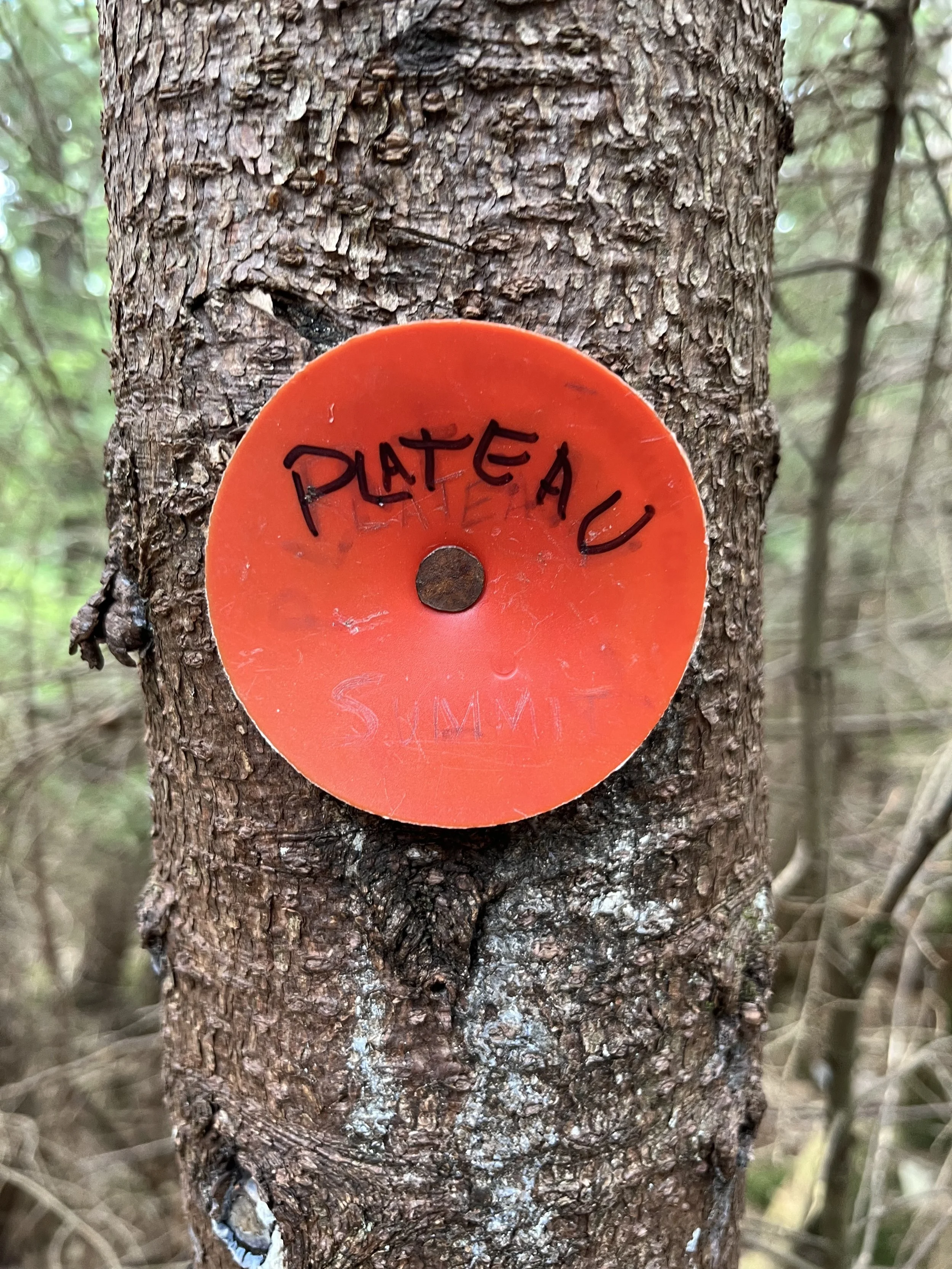
At the top we found a trail tag with “Plateau Summit” sharpied onto the plastic. We took a few photos and rested while jotting down some notes. We were stunned by how damp it felt at the summit. The trees were so verdant. Are the mountain tops raking moisture off the clouds? The thick tangle of downed trees and close knit standing ones feels ancient. The ground is made of predeceased [balsam fir] trees in various levels of decay. The long, flat summit retains water throughout.
We would also learn that a large tract of the summit is most likely virgin forest, regularly subject to blow-down and heavy snows. Wind and weather disturbance is the primary actor upon these trees. Those environmental forces, and human perception of them as sources of damage or harm, is something we have been ruminating on.