Mapping American Chestnut Sprouts on Overlook Mountain
Field Notes from Woodstock, NY
June 2026.
June 4th, 2026:
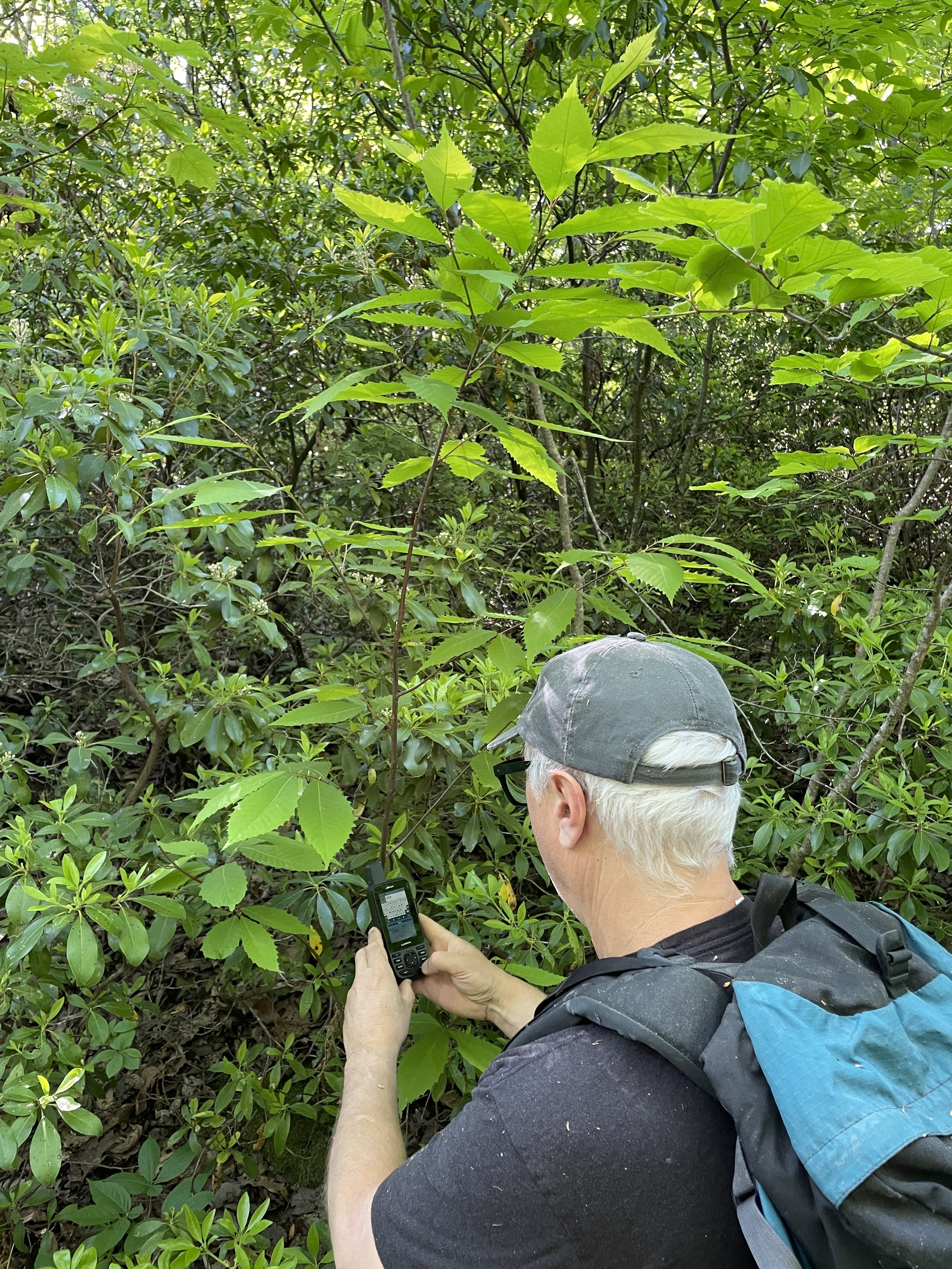
Today we began our survey of American chestnut stump sprouts on Overlook Mountain. We drove up to Woodstock and set off on our walk around 8:30 AM. This was the first outing using our Garmin GPS—still a lot to learn. We marked each chestnut sprout within sight of the trail as a “Waypoint” labeled C###. To make the most accurate marks possible, we climbed and scrambled offtrail to the trees themselves to mark their locations.
It was exhausting and fun work. We worked our way up between 2500 and 2600 feet in elevation–nearing the maximum elevation of chestnut according to Michael Kudish. He wrote that the highest population he discovered on Overlook was about 2775 ft (in “American Chestnut Follows People” from Kudish in the Kaatskills). We marked just under 110 sprouting stumps over the course of our nearly 4-hour hike.
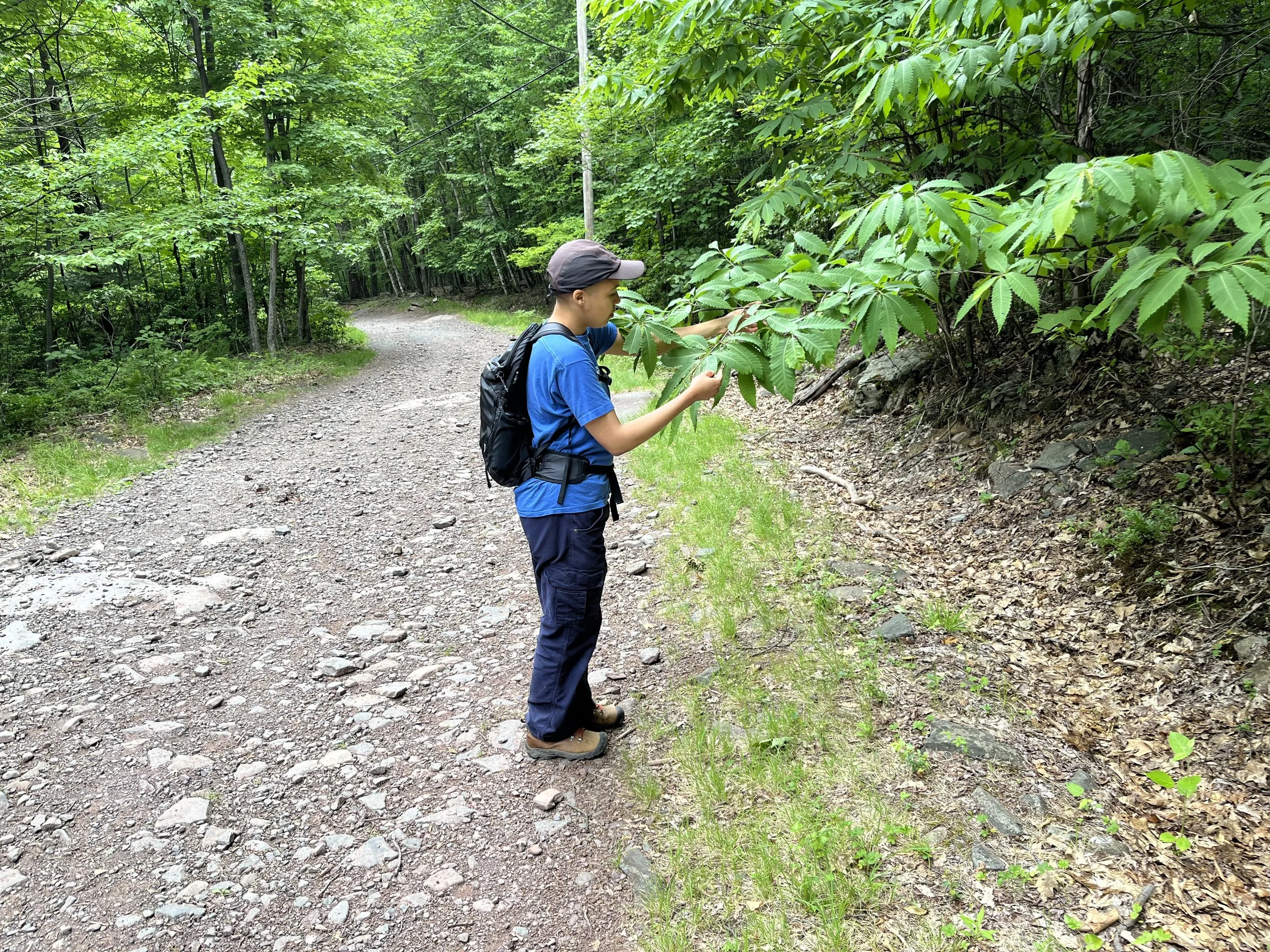
Studying the leaves of one of the larger American chestnut sprouts beside the trail.
We spent some time searching for potential remnant chestnut logs/trunks on the ground, but we didn’t find anything convincing. Later a thought on this occurred to us. Given that the carriage road was active and privately owned between 1911 and the early 1920s while chestnut blight was killing trees in Woodstock, it seemed probable that the trees beside the trail were harvested for their good wood. We know American chestnut trees were often cut or salvaged as blight encroached, and this particular area was trafficked, accessible, and on a repeatedly logged slope. It isn’t a surprise, then, that despite the abundant sprouts and the capacity for chestnut wood to remain fairly intact on the ground, we saw little evidence of those old logs.
If we venture deeper into the woods near an area of clustered sprouts (a grove) where harvest would have been harder to accomplish, would we have a better chance of locating old chestnut logs?
June 17th, 2026:
Our chestnut sprout survey on Overlook Mountain is now complete. We resumed in the 2700 ft elevation range where we had previously paused. Although the prevalence of chestnut was lower than in the clusters lower down on the trail, we identified over 20 living sprouts over the course of ~300ft elevation gain. They appear well beyond the 2775 ft mark.
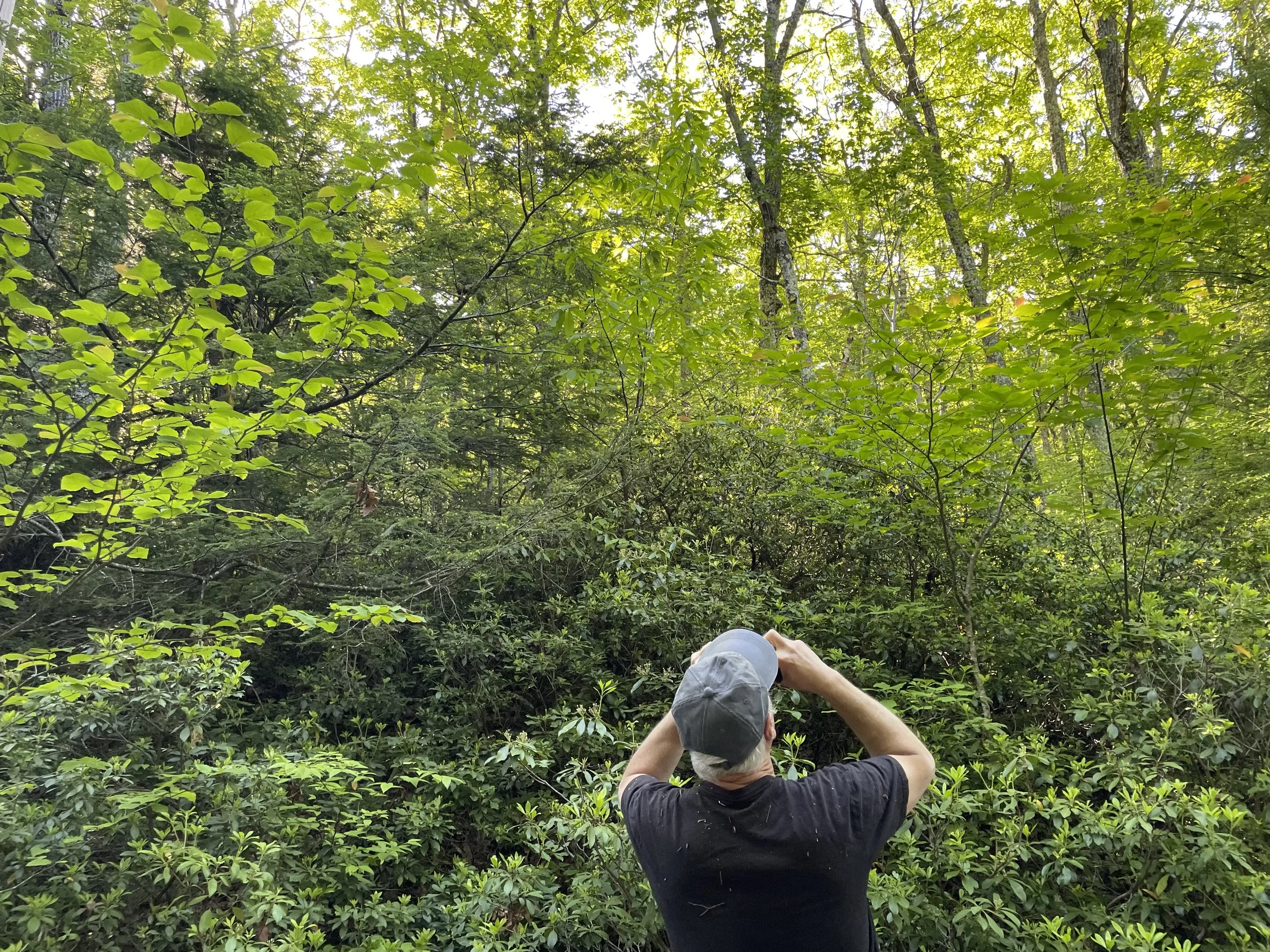
Binoculars have entered our tool kit in the field. They help us differentiate chestnut leaves from beech or chestnut oak at a distance.
Not only that, but we noted a handful of rather large diameter (~6in) robust, healthy-looking sprouts in the 3000 ft range. That was an exciting surprise! Chestnut disappeared by 3100 ft as we began to near the mountain house and summit.
Around the mountain house we noticed a lot of ash. The area was obviously cleared in the past century. Standing ash trees were dead or near dead, but with enough living tissue/nutrient channels to send out sprouts high up on the trunk as well as low down near the roots. The trunk sprout growth was verdant and strong. In general the ash trees were medium-sized to small, and almost all presented with similar sprouting patterns.
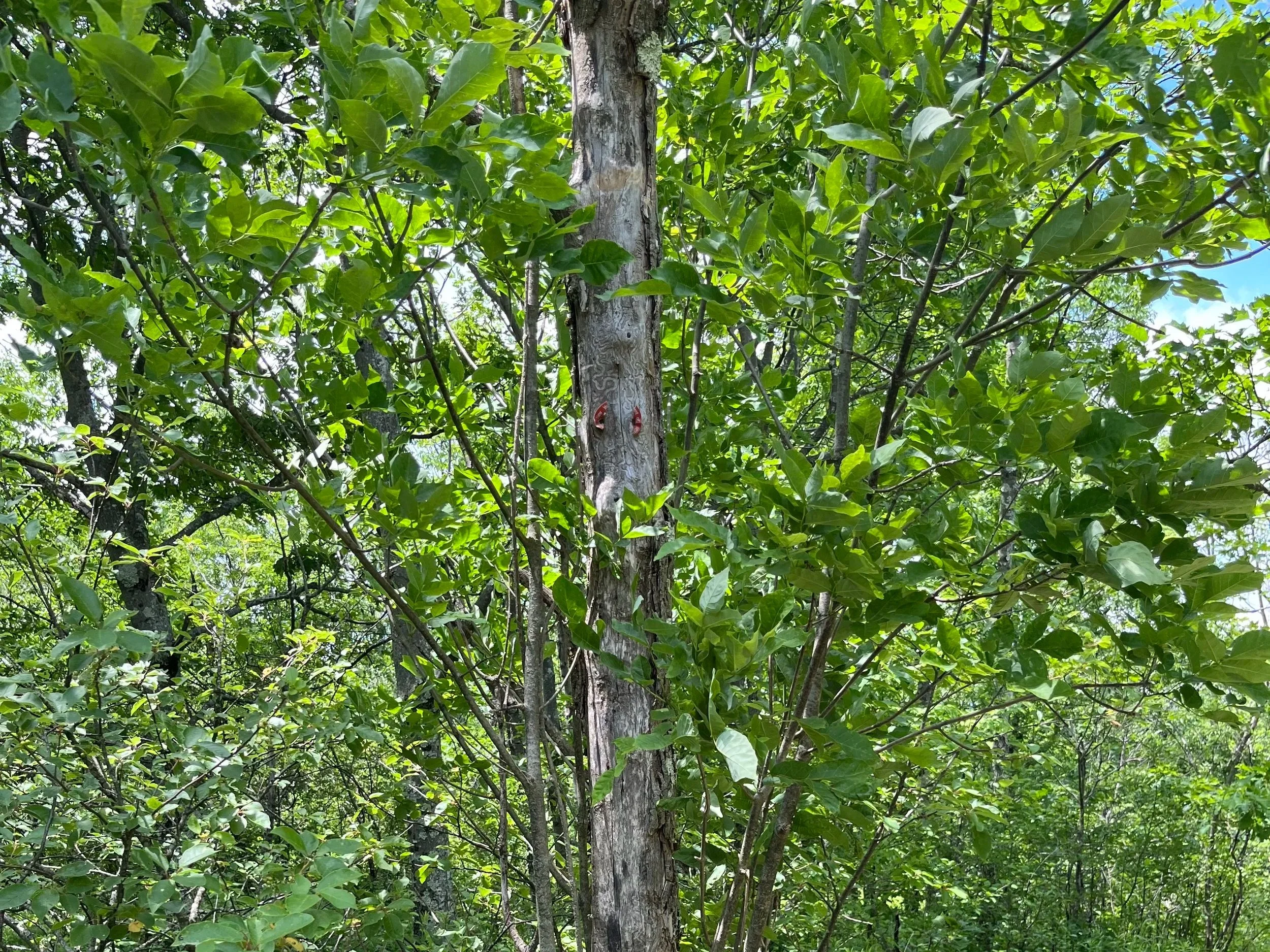
Ash, decimated by EAB feeding galleries, displays epicormic sprouting.
We ate on a broad ledge looking south toward the Ashokan Reservoir and Shawangunk Ridge. We could make out the Mohonk tower from afar. Then we climbed the fire tower at the summit for a brief look at our placement within the Catskills, which was dizzying.
The most memorable part of our walk happened on the way down. While walking and talking, one of our footsteps suddenly evoked an alarming hiss. It was a timber rattlesnake! Just to the right, several inches off the trail, a vibrant golden rattler was slinking its enormous body through the gravel and short grasses. It was jarring and unreal for the first few moments. The snake seemed almost tropical in its patterning and presentation. It was astoundingly beautiful. We watched it continue to wind slowly on its course as another group of hikers heading up stopped to watch it too.
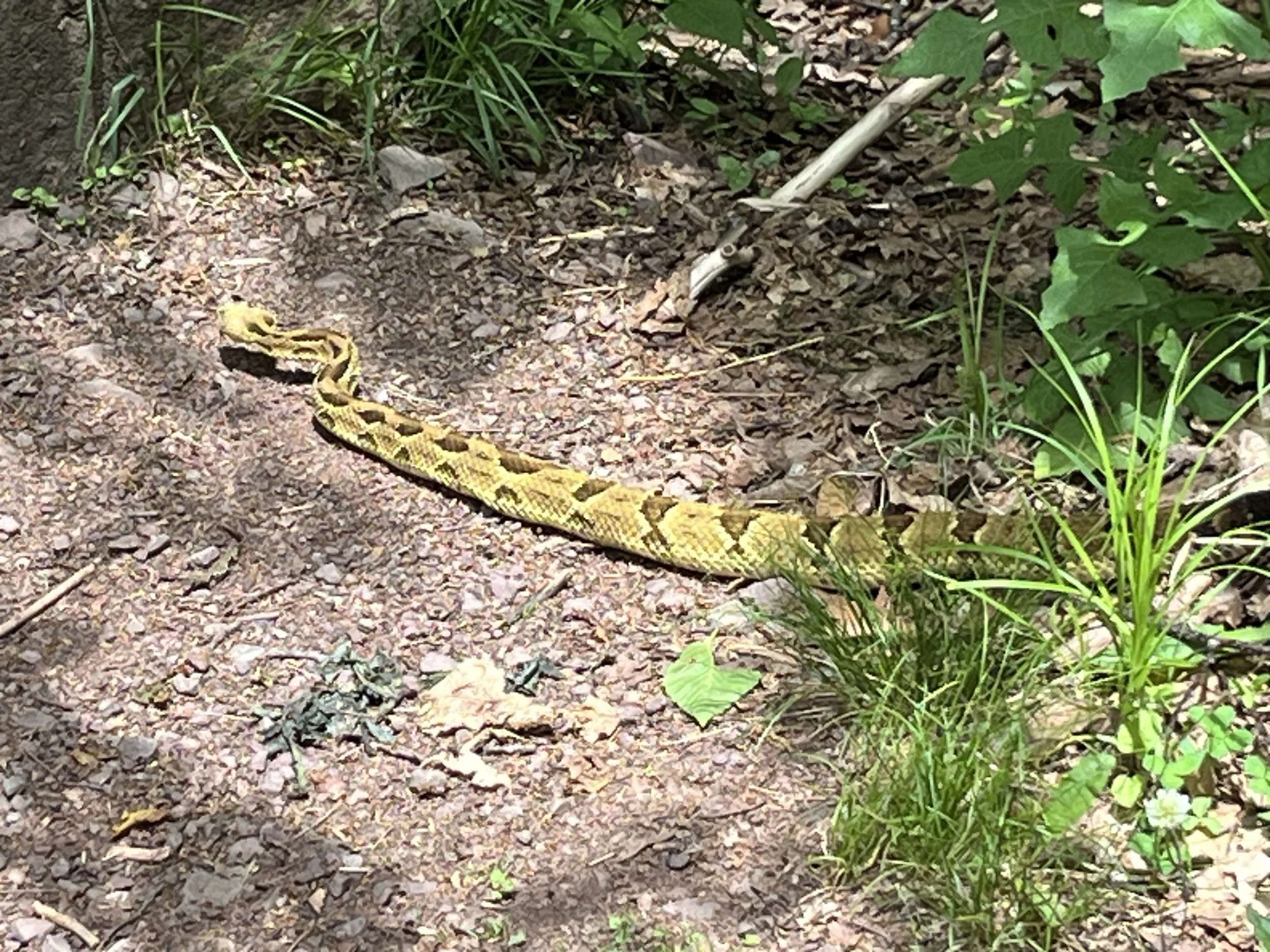
We were amazed. As we walked and talked through the experience, just about fifteen minutes down the trail (barely stepping off to look at chestnuts and harvest a sample leaf along the way) we suddenly spotted another one. What?! This snake was much darker, the blackened tone of its lower half extending over more of its body length. It was smaller, and reacted more aggressively to our observation. Warnings to walkers with dogs ensued.
After the second snake we started to feel really convinced that some kind of leg garter would be a good idea for future bushwhacking excursions. The snake was well within our chestnut survey zone where we had just been diving into the woods off trail to mark trees. What a relief we didn’t have any encounters there!
We joked about the impossibility of seeing another. Two in one day was such a wild and fabulous coincidence. And then, in the last third of a mile or so on the descent, another step of mine sent a sharp rattle off. Holy shit. This last one was angry, loud, and freaked us both out a little bit. The idea of seeing three timber rattle snakes in one day seemed so unlikely that we were simultaneously hyperaware and kind of had our guard down. But no! Three! All three were on the downslope side (the side where we find markedly less chestnut sprouts) and just within a foot or so of the trail in the grass and rocks.
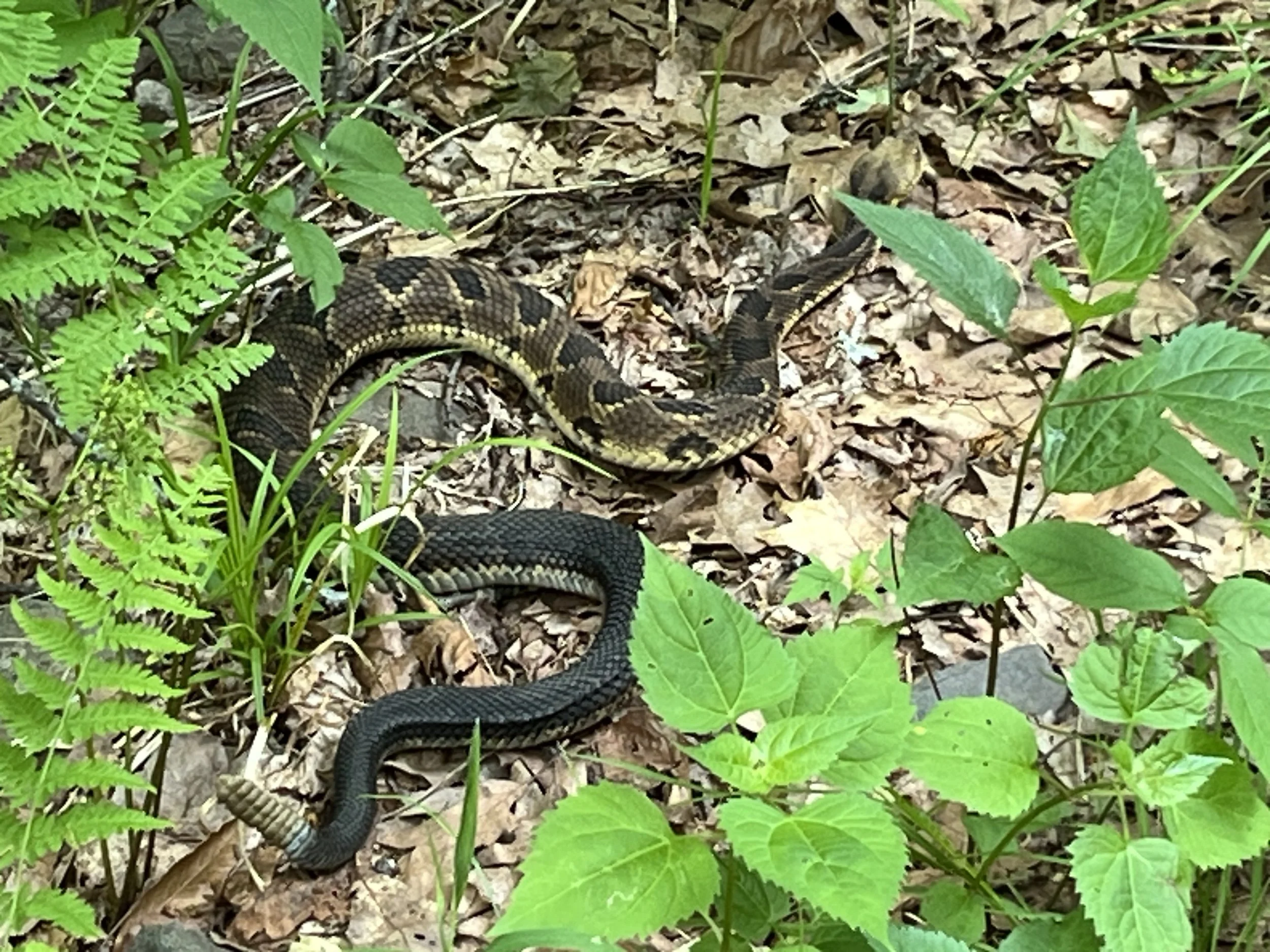
We are guessing the rocky, gravelly, open-sun, south-facing trail is attractive for sunning, but that the frequent passersby make snakes retreat from the middle of the path.
All in all, our walk on Overlook was spectacular and a little frightening. Sublime might be the word.