Mountain Top Library
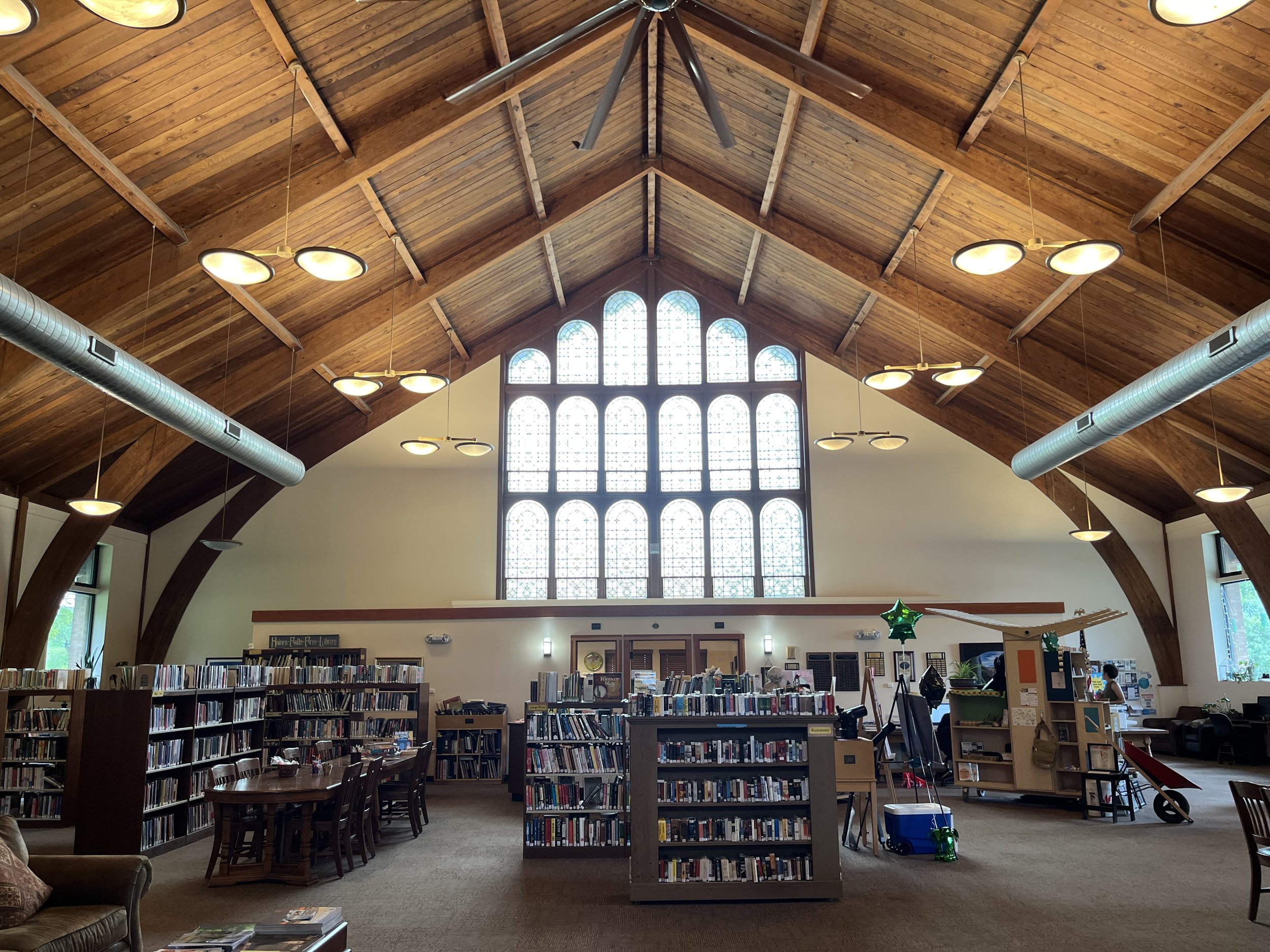
The Mountain Top Library is a distinctly wonderful place. The building is an adapted church with a vaulted ceiling supported by tremendous wooden arches.
Its spacious interior is like a communal living room, where lounge seats, work tables, bookcases, toys, and frequently, free coffee and snacks, sprawl out and beckon. Illuminated by a stained glass window on the front-facing wall, the library seems to sanctify the everyday.
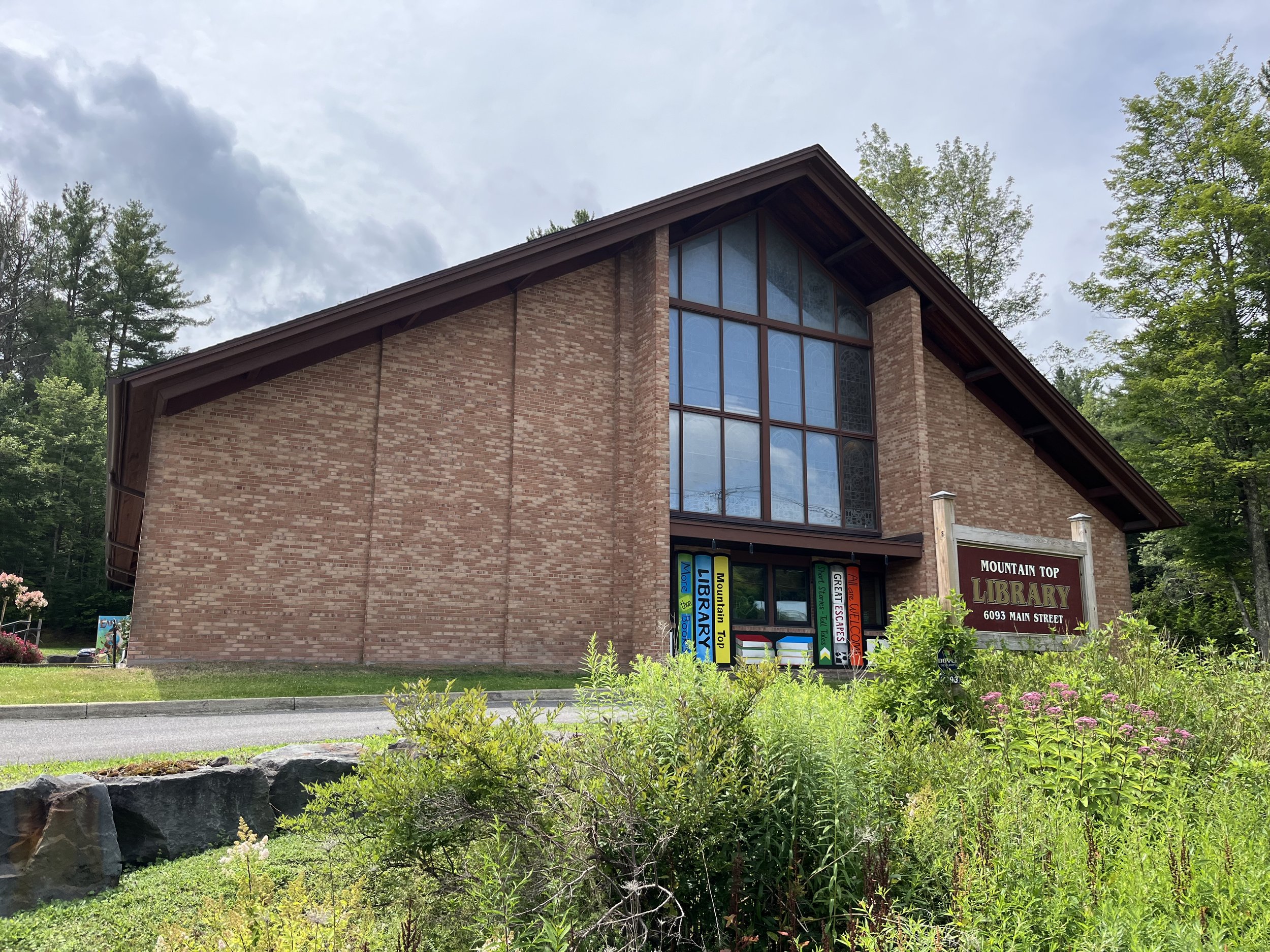
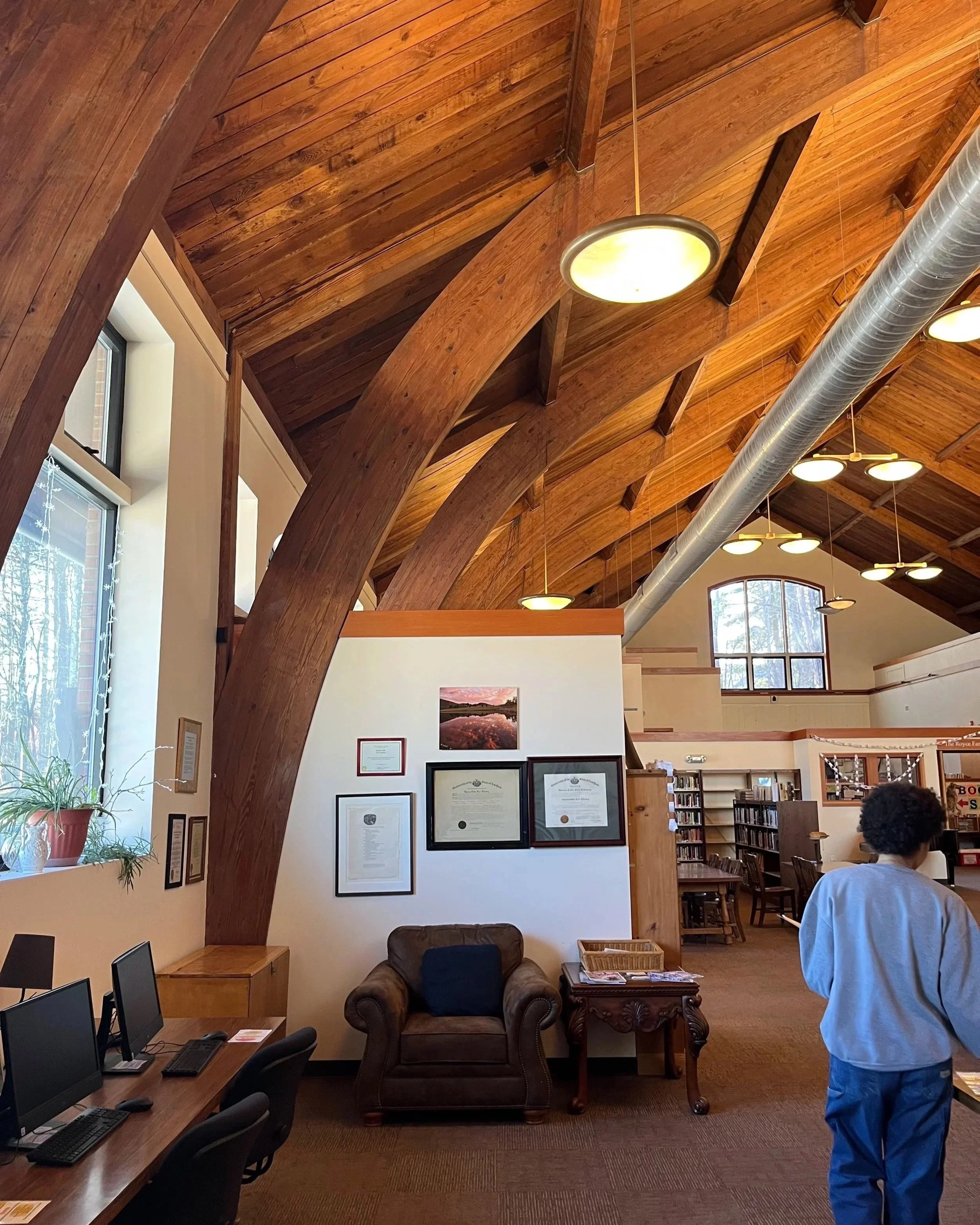
We were awestruck by this unique library during our first visit in the summer of 2024. As we wandered the space, we were fortunate to meet Jacqueline Elmo-Emel, the remarkable library director. It was immediately clear that Mountain Top deserved an ambitious and beautiful project.
The library serves the village of Tannersville and hamlet of Haines Falls in Greene County, NY, near some of the Catskills best-known forests. North-South Lake and Hunter Mountain Ski Resort draw seasonal residents and recreational vacationers. The year-round community of Tannersville (population <1000) knows the challenges of both rural mountain life and gentrification. Jaki told us that alongside programming and lending materials, the library spends a great deal of time connecting folks to resources that are hard to find in a remote place.
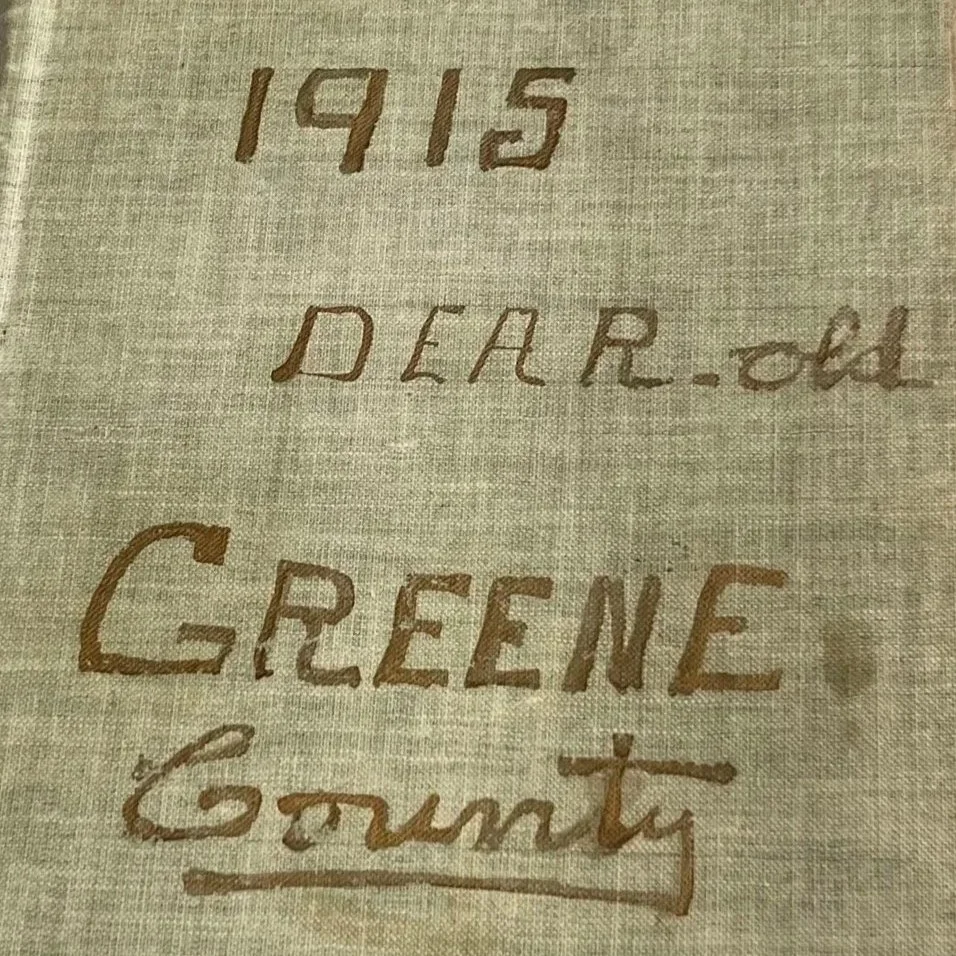
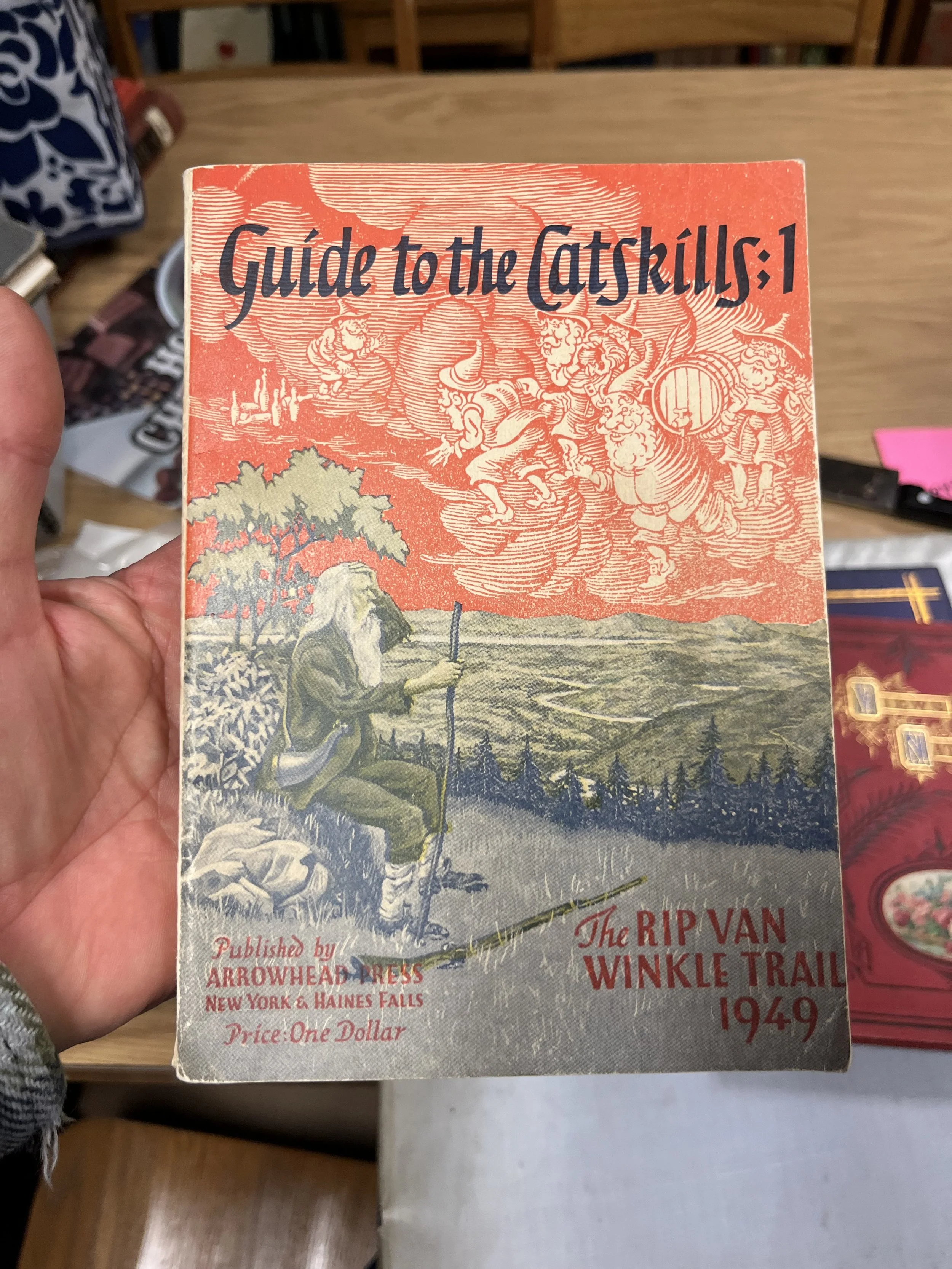
Over the following year, we had numerous conversations with Jaki to discuss potential spaces and concepts for a Processing Collapse artwork. One day, she mentioned a need for increased space to house the non-circulating local history collection. We saw the amazing materials stashed in a staff office, including atlases, maps, local publications, and guides to the Catskills. We began to wonder how our work might host and engage with local history.

Eastern Hemlock
To locate the forest in Tannersville’s past, we started with the name of the village itself. Workers from nearby leather tanneries made a settlement on the mountain; hence the name “Tanners’-Ville.” Other Catskills place names reflect this industry too. Prattsville and Palenville, also in Greene County, are named after “tanlords.” During the 19th century, regional leather tanneries were using the bark of Eastern hemlock trees to process animal hides into leather.
Hemlocks were abundant on slopes and along mountain brooks across the Catskills. Bark-peeling crews felled these trees to strip their bark, or girdled them standing, usually leaving the wood to rot. This went on for decades, denuding stand after stand of hemlock and causing fundamental changes to the ecosystem. The extraction led to erosion, warming streams, and most notably, the replacement of Eastern hemlocks in many places with fast-growing hardwood trees. The species was nearly obliterated in the region. By the end of the 19th century, the tanbark industry ground to a halt as resources dwindled drastically and more efficient tanning methods came onto the scene.
Eastern hemlock already holds a major place in Tannersville history. Its significance as a resource and the impact on local industry has been well-documented. Forest preservation permitted the slow regrowth and return of hemlock throughout the 1900s, and second-growth stands have established around Greene County. This resilience is remarkable. However, the species faces an existential threat today. An imported insect, hemlock woolly adelgid (HWA) is bringing on the mass mortality of Eastern hemlock throughout its range. In the lower and mid-Hudson Valley it has already killed innumerable trees, upending habitat once again.
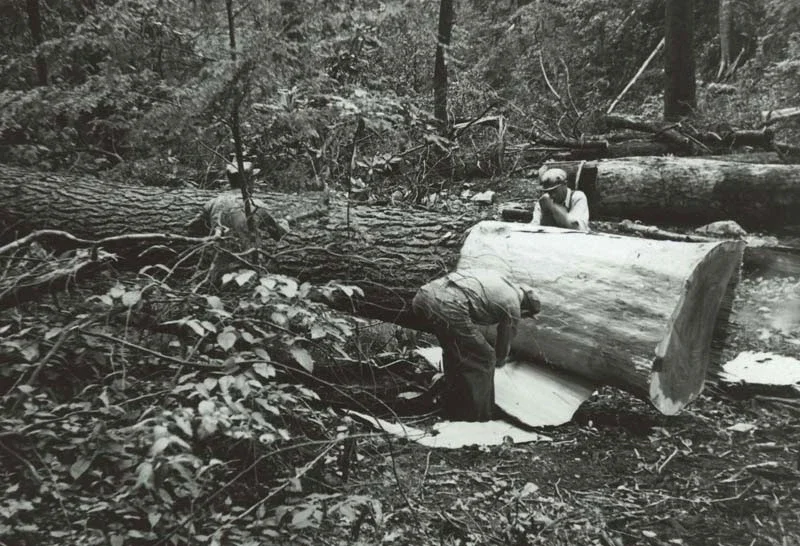
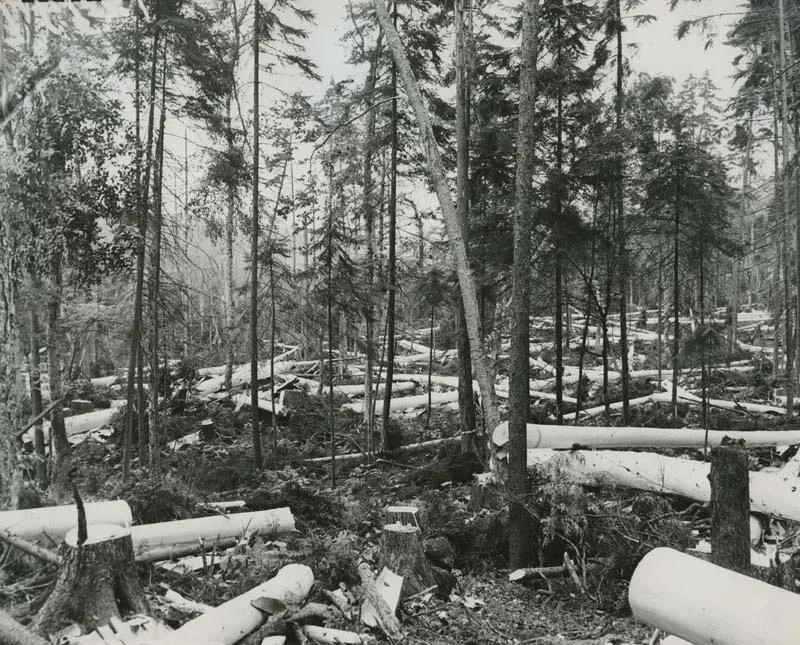
Barkpeelings in the Adirondacks, c. 1890s-1900s.
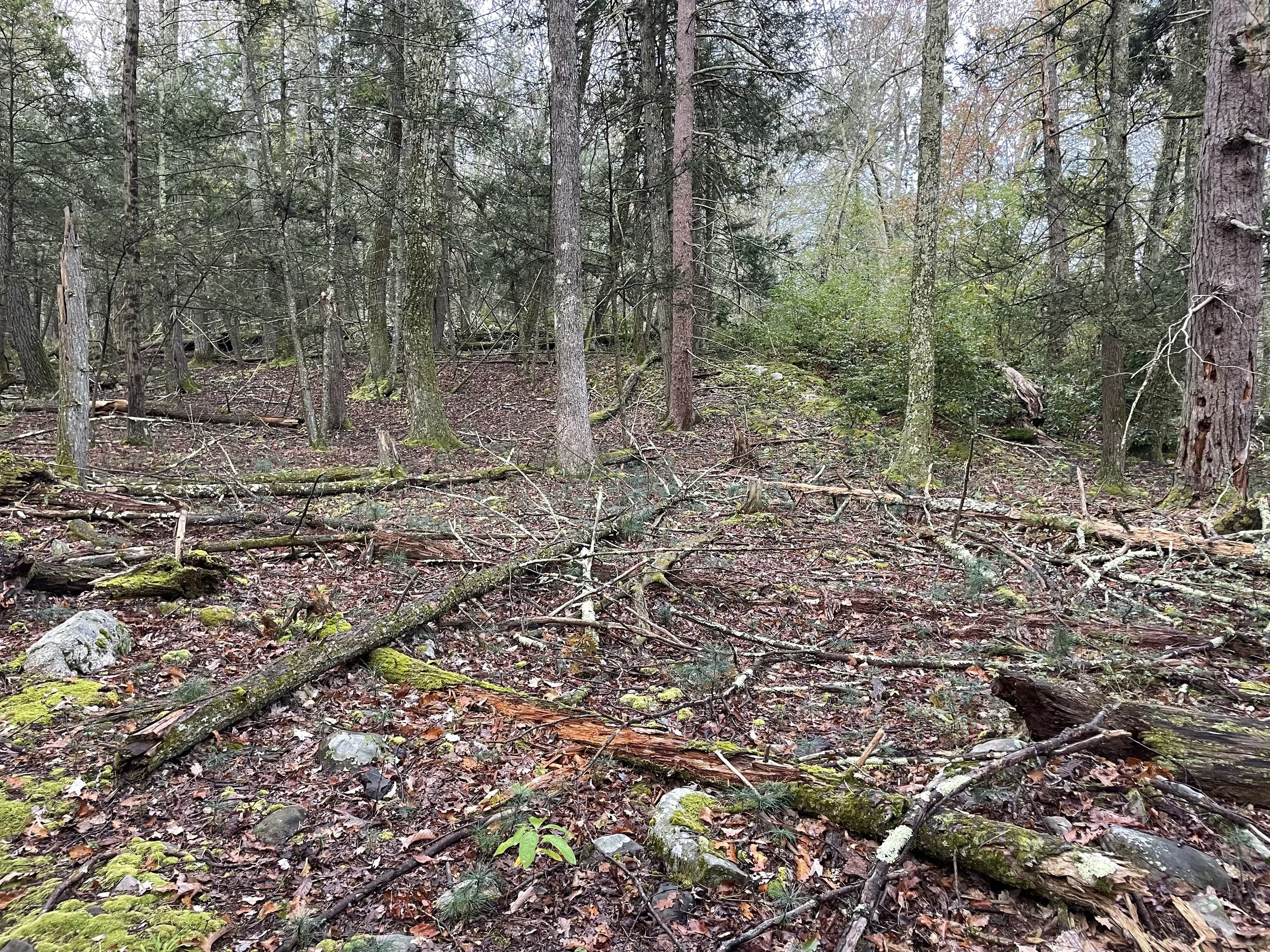
HWA-afflicted hemlocks in Mohonk Preserve, 2025.
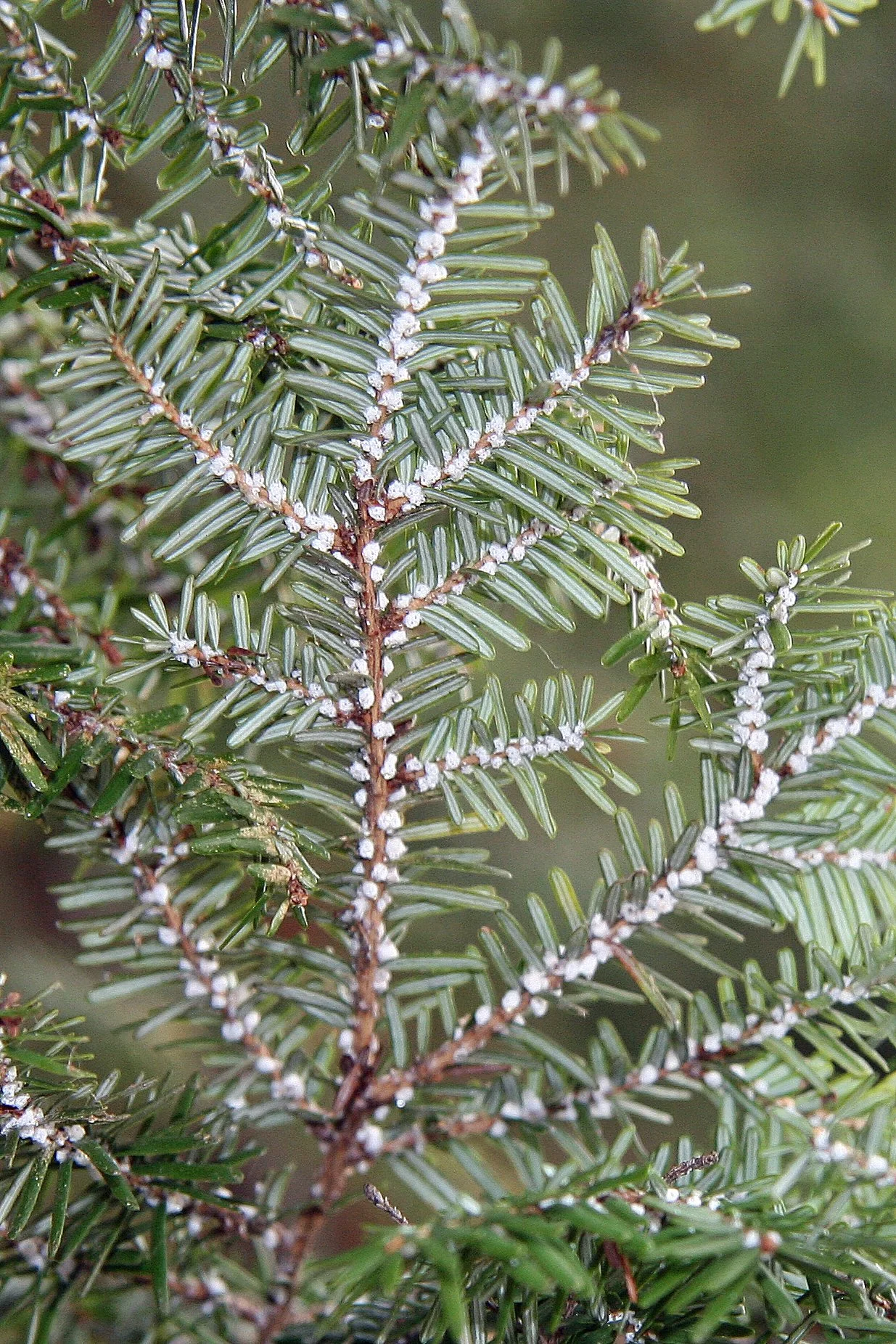
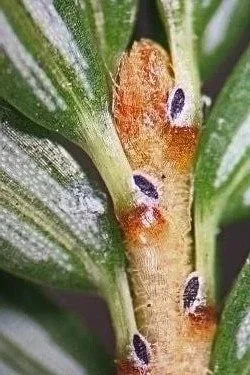
Since the death of these trees is no longer happening under axe and saw, it is easy to feel disconnected from this shift in the forest. Nature lovers on hikes in the Catskills may remain unaware of the active collapse, and our role in it. The adelgid was imported to the U.S. through Asian hemlock trees shipped to nurseries for ornamental planting. Like ash and American chestnut, the mass mortality of this native tree is collateral damage from our global trade systems. As climate change warms our winters, the livable range for HWA extends farther north and hemlocks face increased threat.
Uprooted, Haines Falls: our first experiment with hemlock.
We were invited to participate in an art event called The Longest Day by artist friend Alexander Lyle. We had visited Alex in Haines Falls (about 15 minutes from Mountain Top) to see a hemlock that had uprooted on the forested edge of the property. These fallen trees are a distinct feature of the tree’s decline; even hemlocks that are not heavily infested can become substantially weakened by HWA, and easily pull out of the ground in strong winds. Hemlocks have shallow, broad root systems that typically serve as excellent stabilizers against erosion. Today, the ornate, tangled root masses can be found propped up in our forests, announcing fallen trees. As our first foray into exploring hemlock collapse, we decided to excavate the roots of this tree.
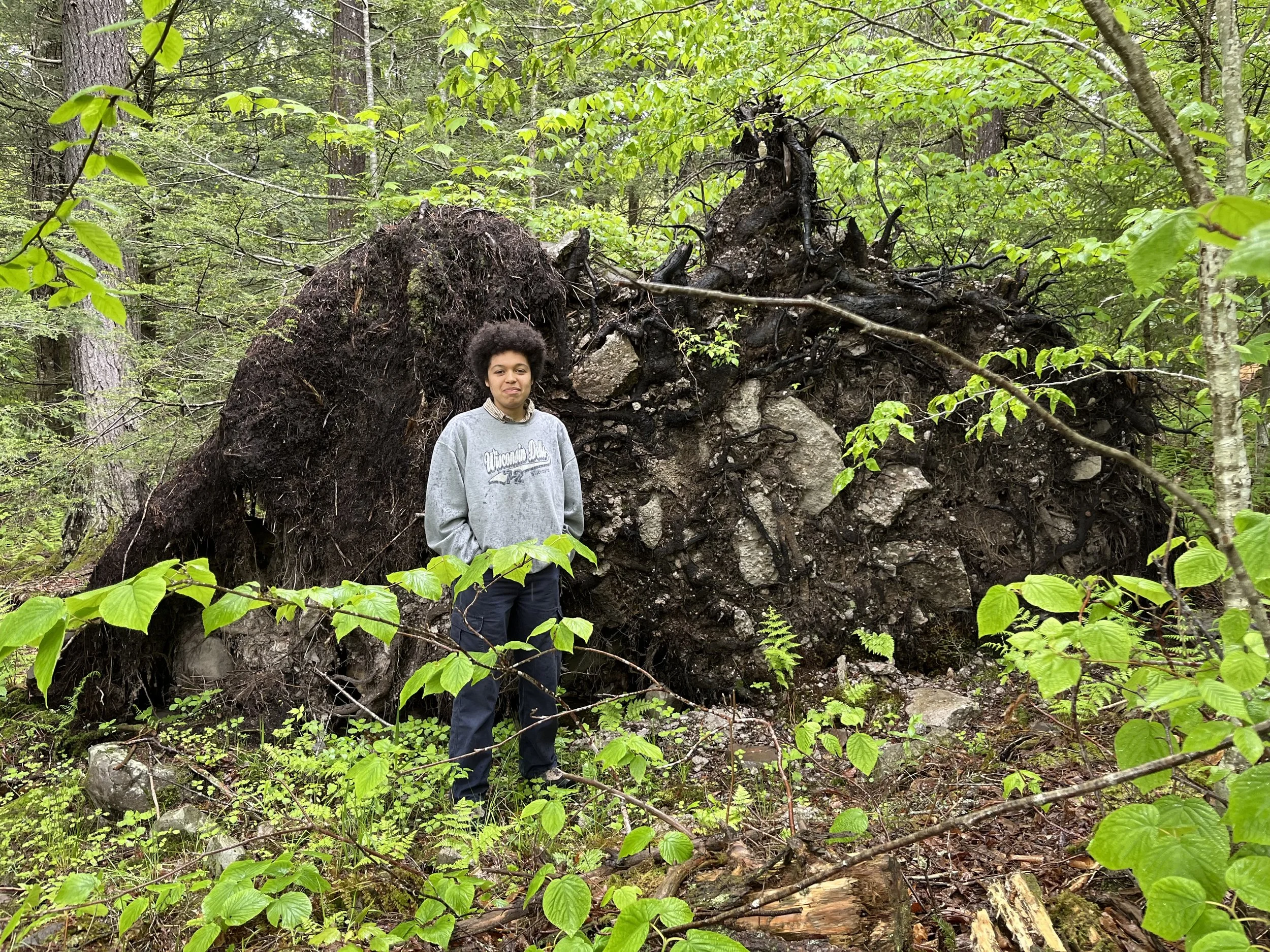
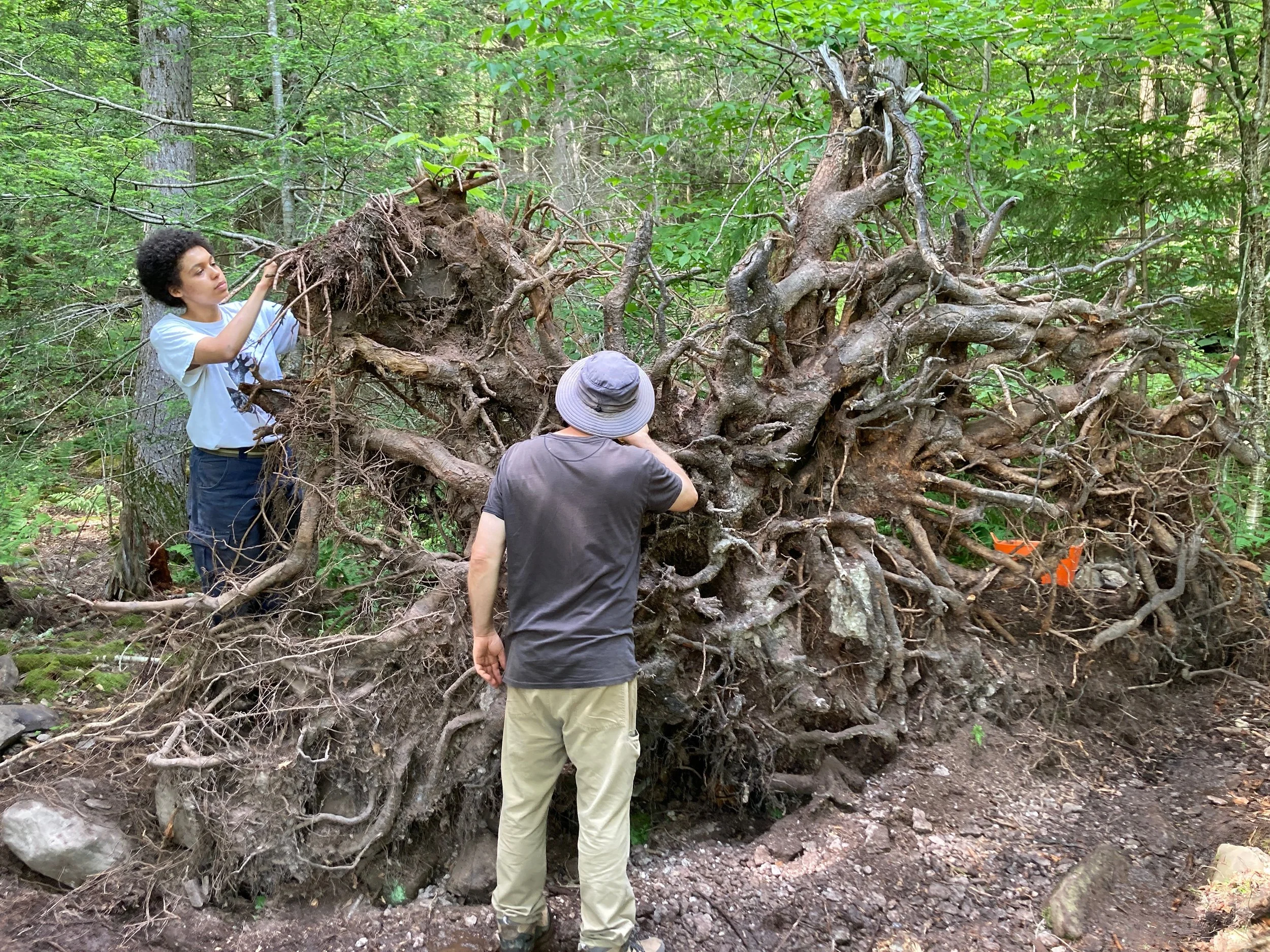
Clearing the mass was meditative and archeological. We used small metal tools and a delicate touch to pry and loosen the compacted dirt and stone. Revealing the aesthetically stunning entanglement of a single tree that had died in a sick forest was beautiful and heartbreaking in turn. As the species dies, we get to see it in ways we never could, or never bothered to.
We cleared the roots over the course of two hot days, joined by friends and visitors. Ultimately the root mass would not become a part of our library proposal, but it was essential for building our familiarity with hemlock in its modern state.
Library Proposal
A constellation of relevant factors was coming into focus. Tanbark industry in the Catskills, the Tannersville local history collection, and modern-day Eastern hemlock decline all seemed crucial. Synthesizing our observations with the local context, we worked to craft a public artwork proposal for the library that would preserve and illuminate the tree:
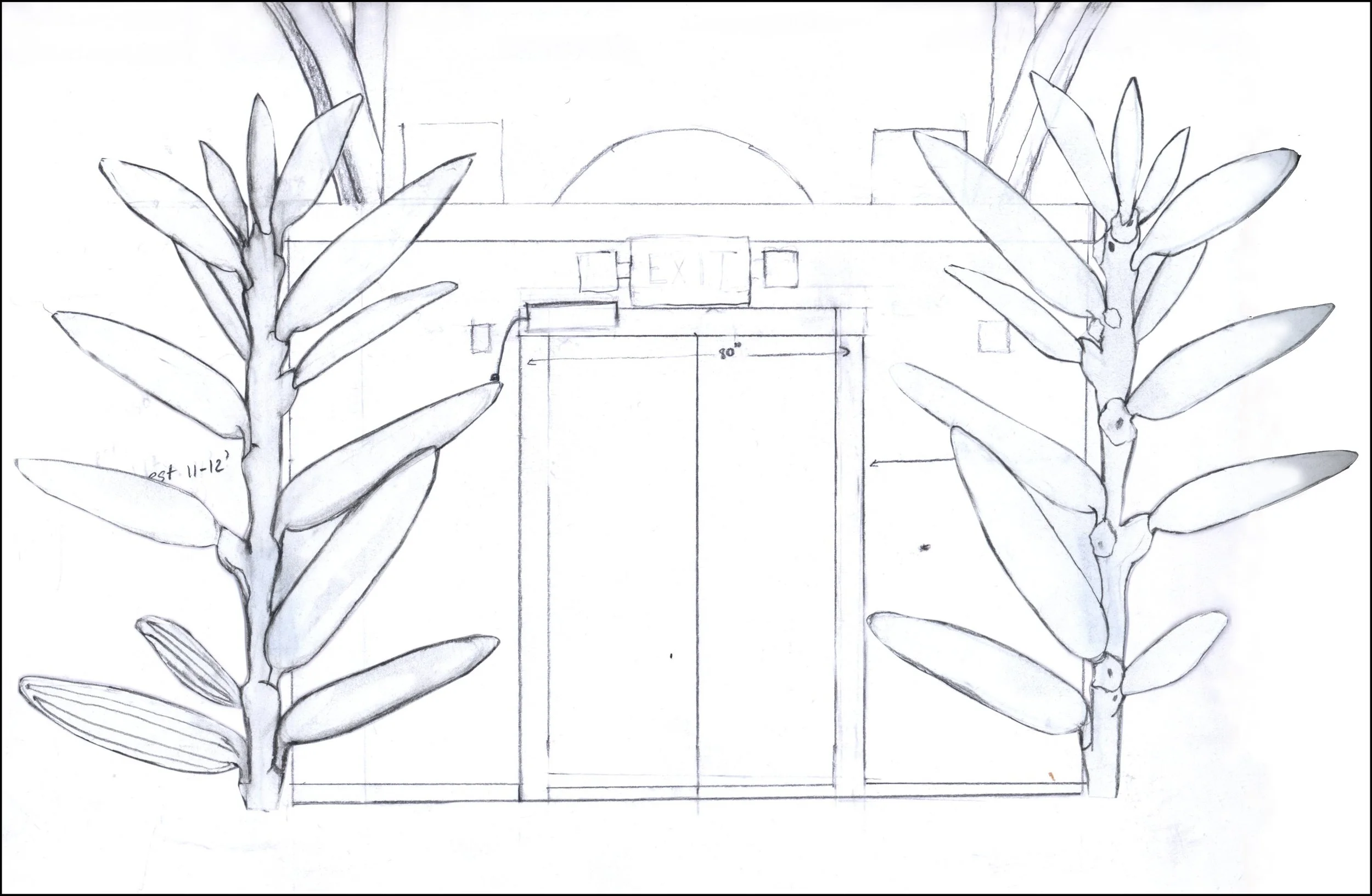
Processing Collapse will construct and install two ten-foot tall, hand-carved wooden sculptures of Eastern hemlock boughs for the vestibule of the Mountain Top Library. Each totem-like carving will render the needles, growth nodes, buds and stem of Eastern hemlock at 125 times its living scale.
Additionally we will craft two cabinets, inspired by 19th-century specimen displays, to house the library's local history collection. This project responds to the range-wide decline of Eastern hemlock due to the non-native hemlock woolly adelgid (HWA) and situates the tree in Tannersville history.
One source of inspiration for this proposal was rural folk art. Subtractive wooden sculpture is a strong tradition across the Catskills through hobbyist chainsaw bears and other figurative works made of logs. These familiar creations are labor-intensive and often use remnant wood from natural disturbance or logging. A well-known, higher brow instance of this kind of work is the axe hewn Maverick Horse at the Maverick Concert Hall in Woodstock. John Flanagan used an American chestnut log as his material in the decade after chestnut blight struck the region.
As a large-scale botanical specimen, the sculpture will create an opportunity to learn how to identify hemlock. Libraries are lived-in spaces that are visited and revisited by community members over years. We hope this generates familiarity and fondness with the tree.
The bough is also a site of susceptibility. Hemlock wooly adelgid colonizes trees at the junction of needle and branch. There, they suck the sap from old and young hemlocks alike, killing them. The scale of this work will make it possible to render the insect, which is near-impossible to see without magnification. The life and decline of hemlock will be given visibility in this work.
The decision to construct display cases for the local history materials is an act of service to the library that gestures toward the importance of hemlock in Tannersville history. Our simple design, inspired by 19th century natural history cabinets, is in conversation with the botanical specimen sculpture, notions of extinction, and the era of tanneries. The new shelving units will make it possible for the local history collection to have a presence on the main floor of the library, increasing exposure to the materials.
If, as scientists project, the tree continues its track toward extirpation, the library will hold a precious remnant and reminder of enormous loss. In our current moment, as hemlock still lives, the work is a catalyst for curiosity and paying attention.
Harvest
In January of 2026, we took a few trips to scout for fallen hemlocks in the woods around Tannersville. One day we pulled into the parking lot of the Kaaterskill Rail Trail in Haines Falls and were greeted by an enormous root mass. When we walked over to investigate, we found a large, still-green, uprooted Eastern hemlock. It had fallen straight across the public trail.
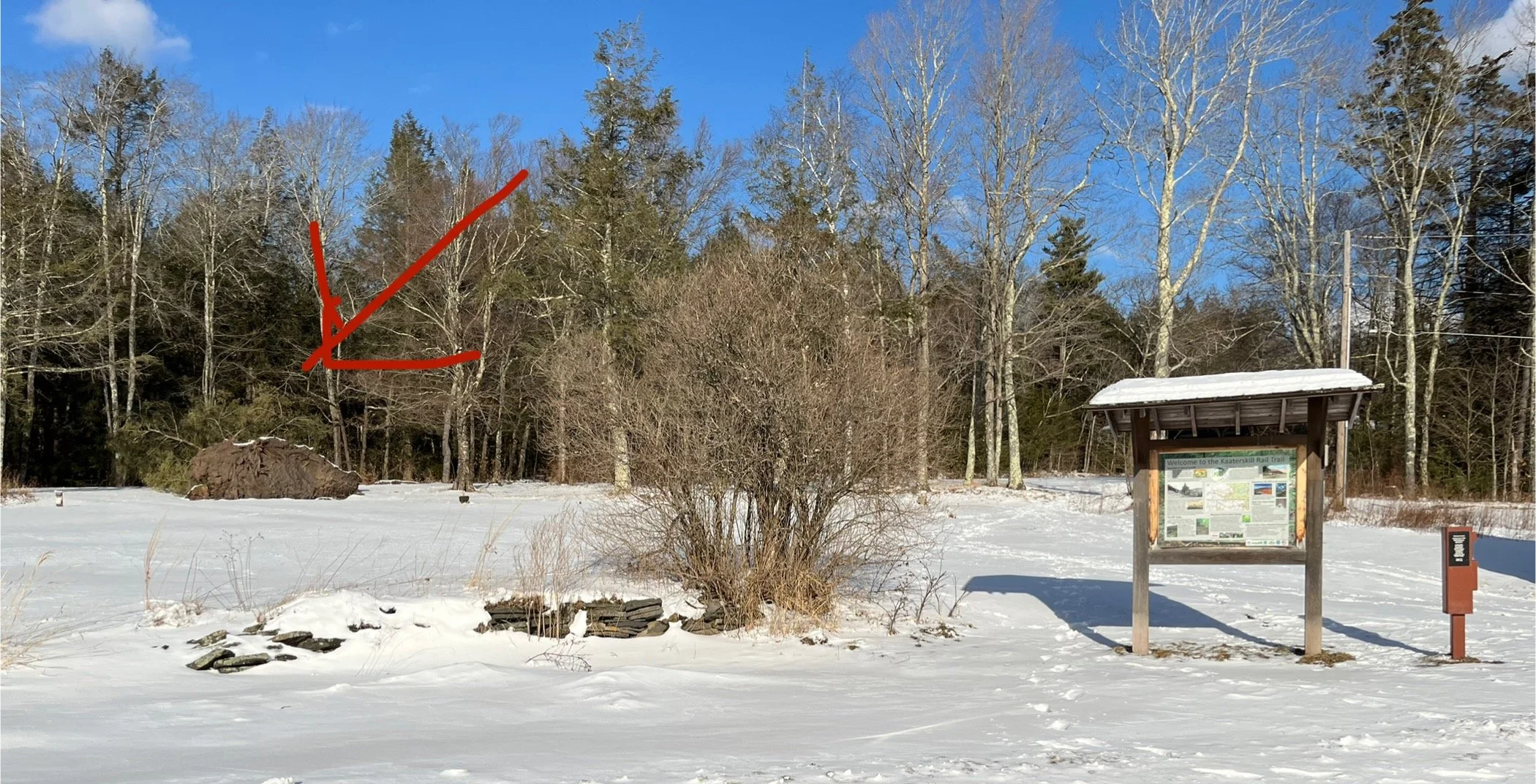
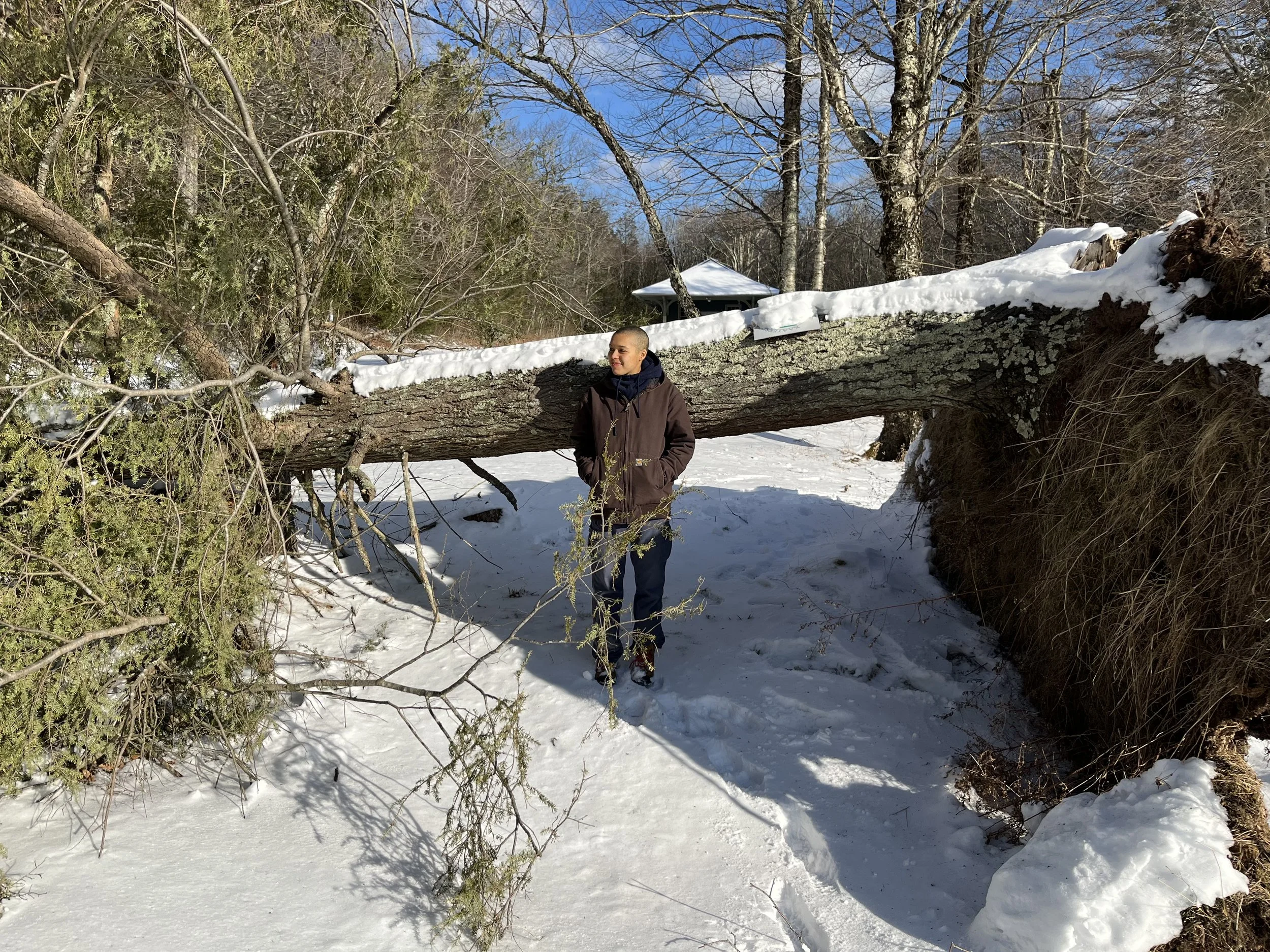
The tree was on the grounds of the Mountain Top Historical Society and former Ulster & Delaware Railroad station. With a 20 inch diameter near the bottom, it seemed like the perfect material for both carved boughs and at least a portion of the display cabinets. We raced to the Mountain Top Library to share our discovery with Jaki and ask for help connecting with the historical society. Thanks to her enthusiastic introduction, we quickly received an affirmative response from MTHS. They were eager for the tree to be integrated into a historically relevant project for the community.
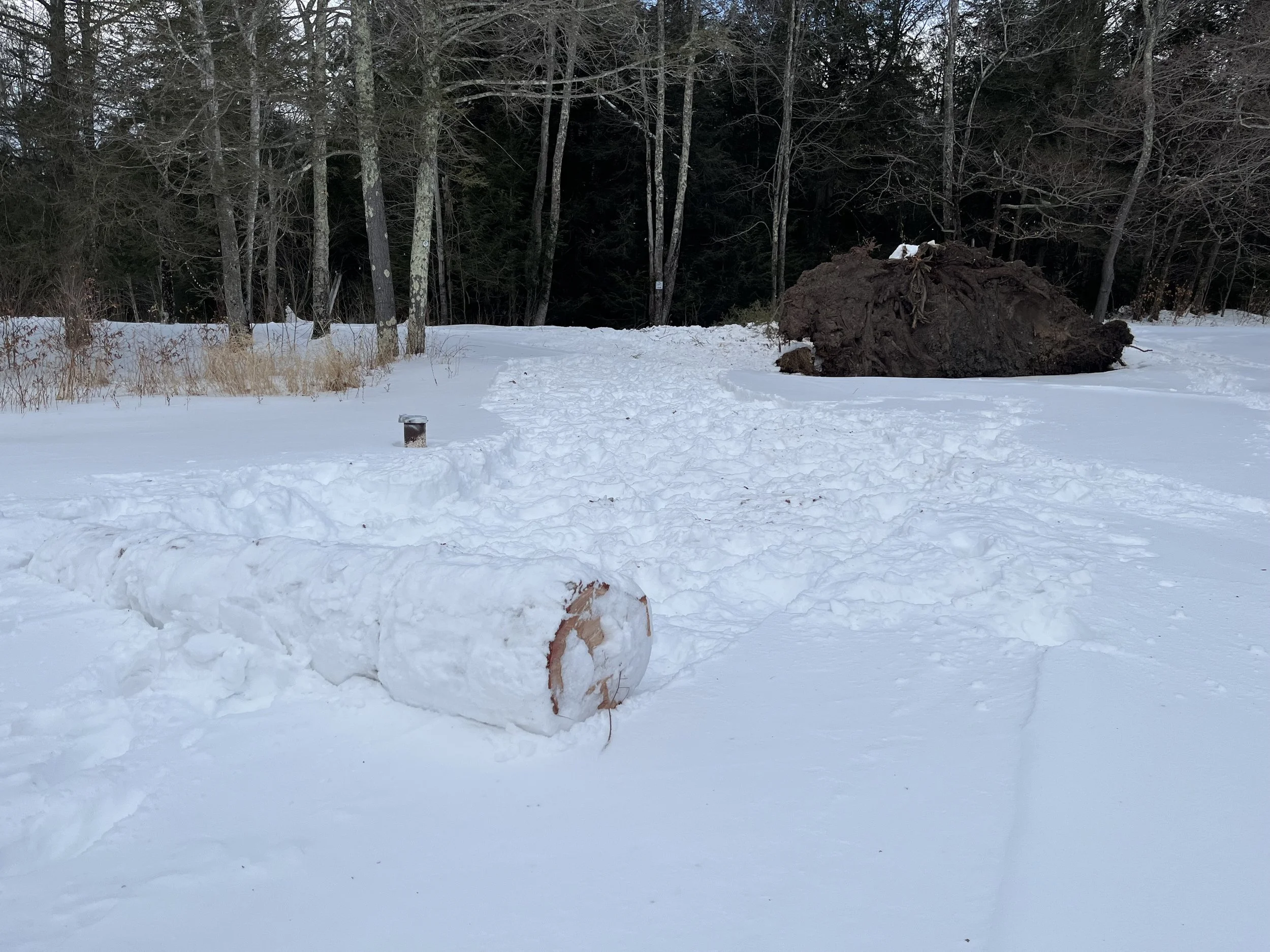
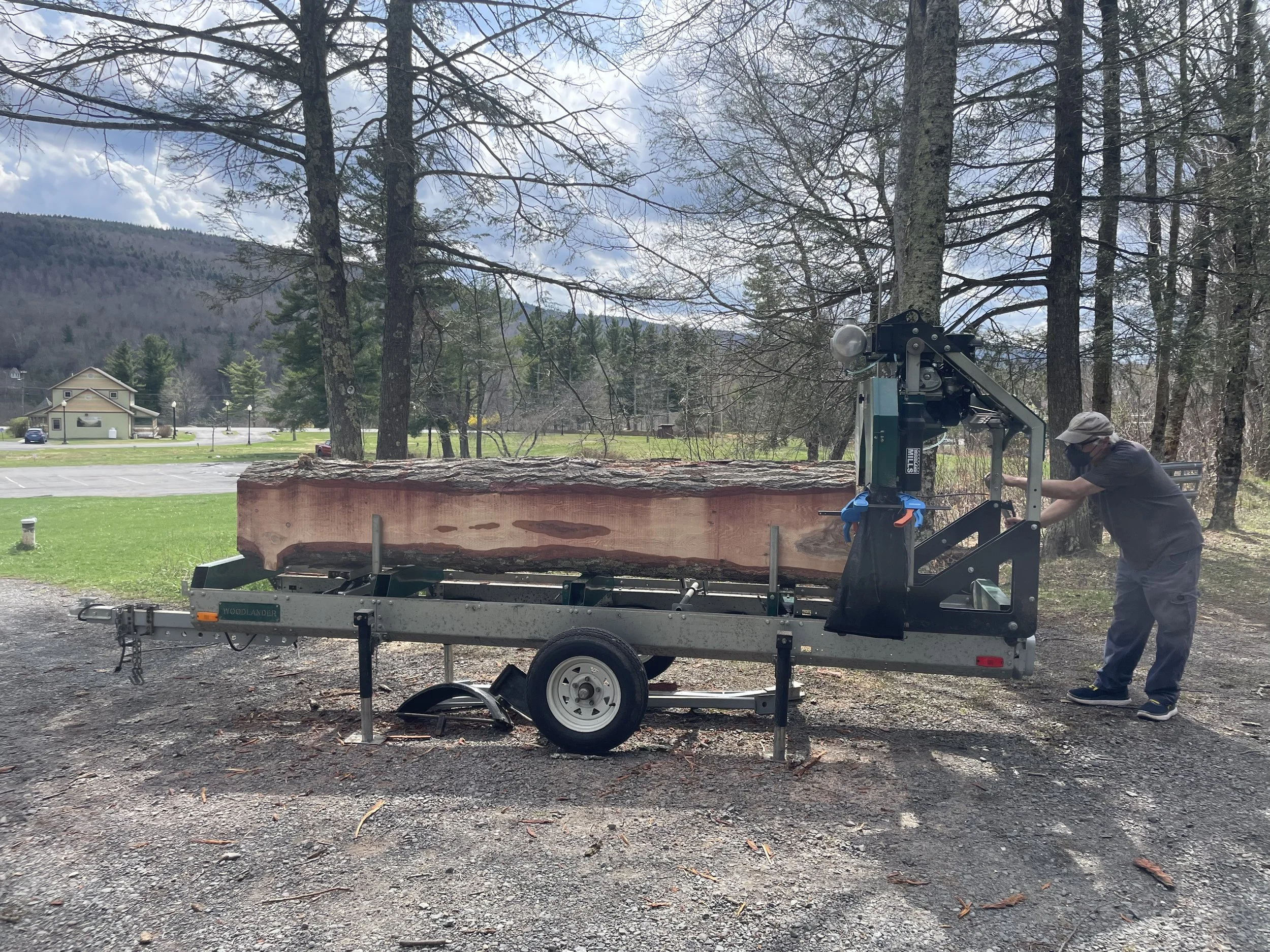
Between February and April, we harvested this log segment by segment. This work was slow and sometimes difficult. The tree was partially suspended (near the base) and partially buried in the deep snow when we began our work. We extracted a ten foot section and rolled it downslope while more than a foot of snow was on the ground. This material was milled into two beams for the boughs and slabs for needles. The largest log had to be milled onsite, because it was too large and heavy for safe transport using the trailer we have access to. While milling, we extracted two long nails and a bullet from the wood.
Carving and Fabrication
Planning and drafting the carved bough took time. Looking at hemlock specimens under a compound microscope helped us better understand the fine details of the bough’s texture and form. It was especially exciting to see the stomata, small pores where gas exchanges. These tiny holes appear to the naked eye as the distinctive white lines on the underside of needles. In the large-scale carving, the stomata will be more perceptible.
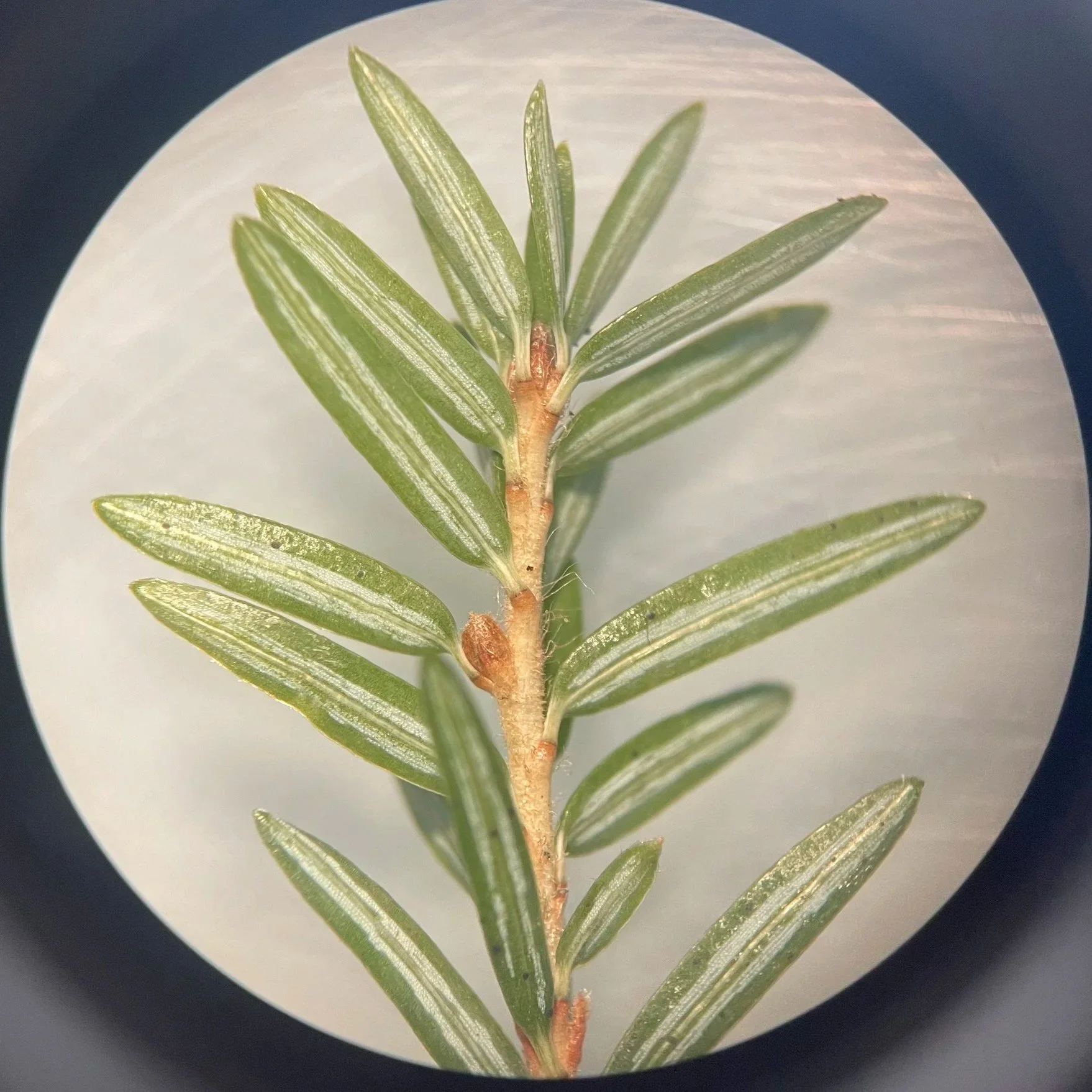
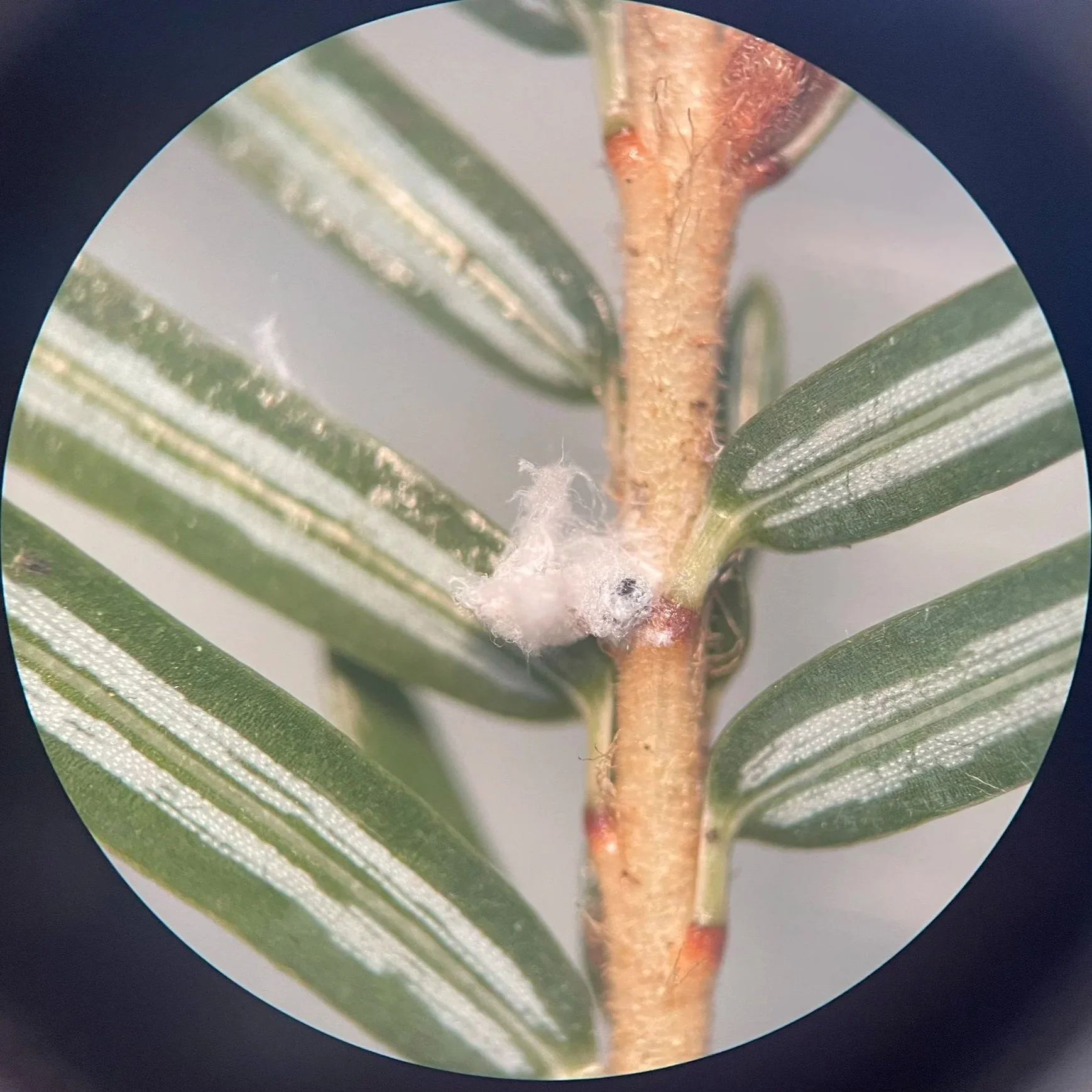
Careful measurements of the actual bough dimensions were taken using digital calipers. These were used to translate the branch into appropriate proportions for the artwork.
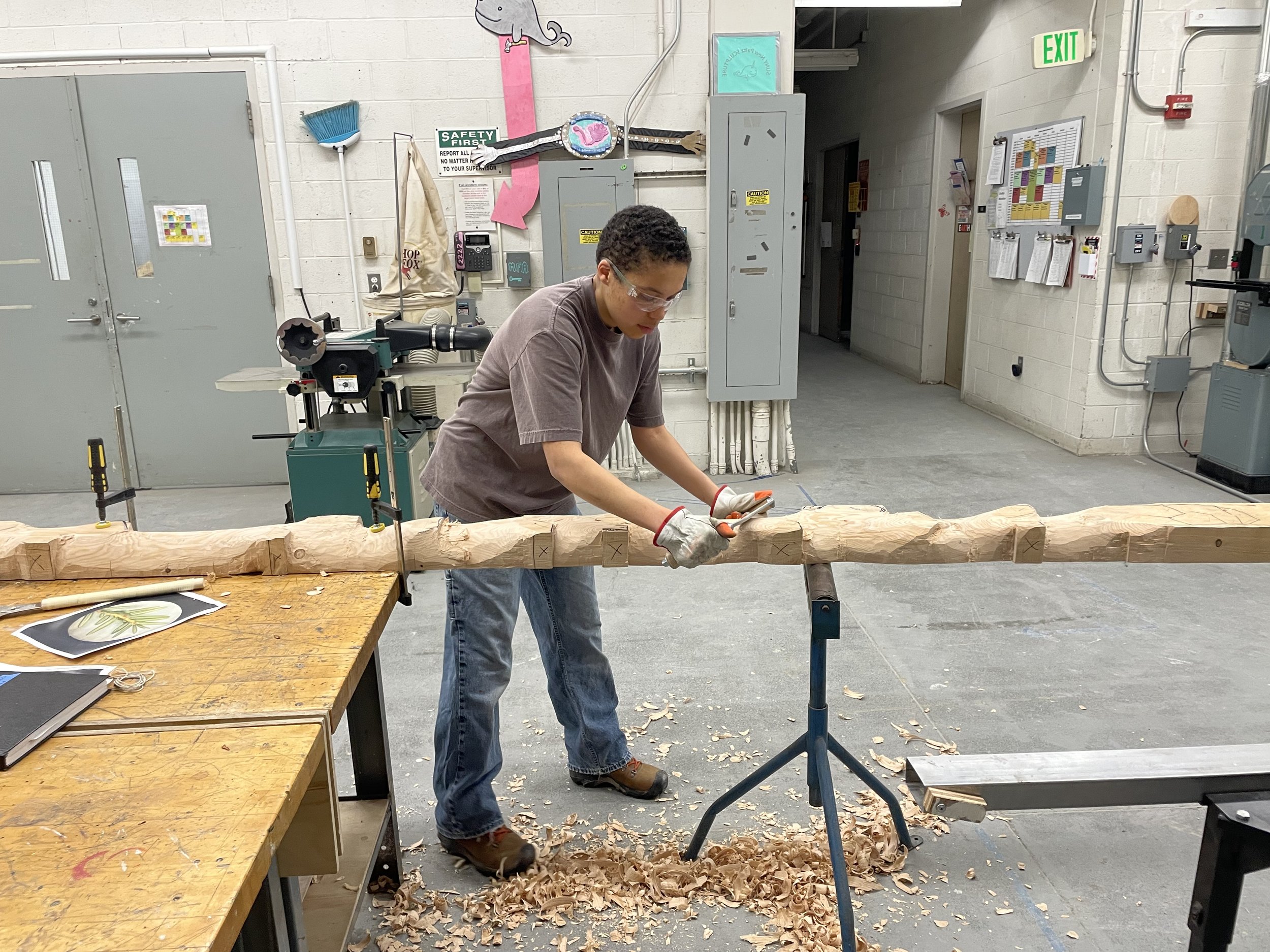
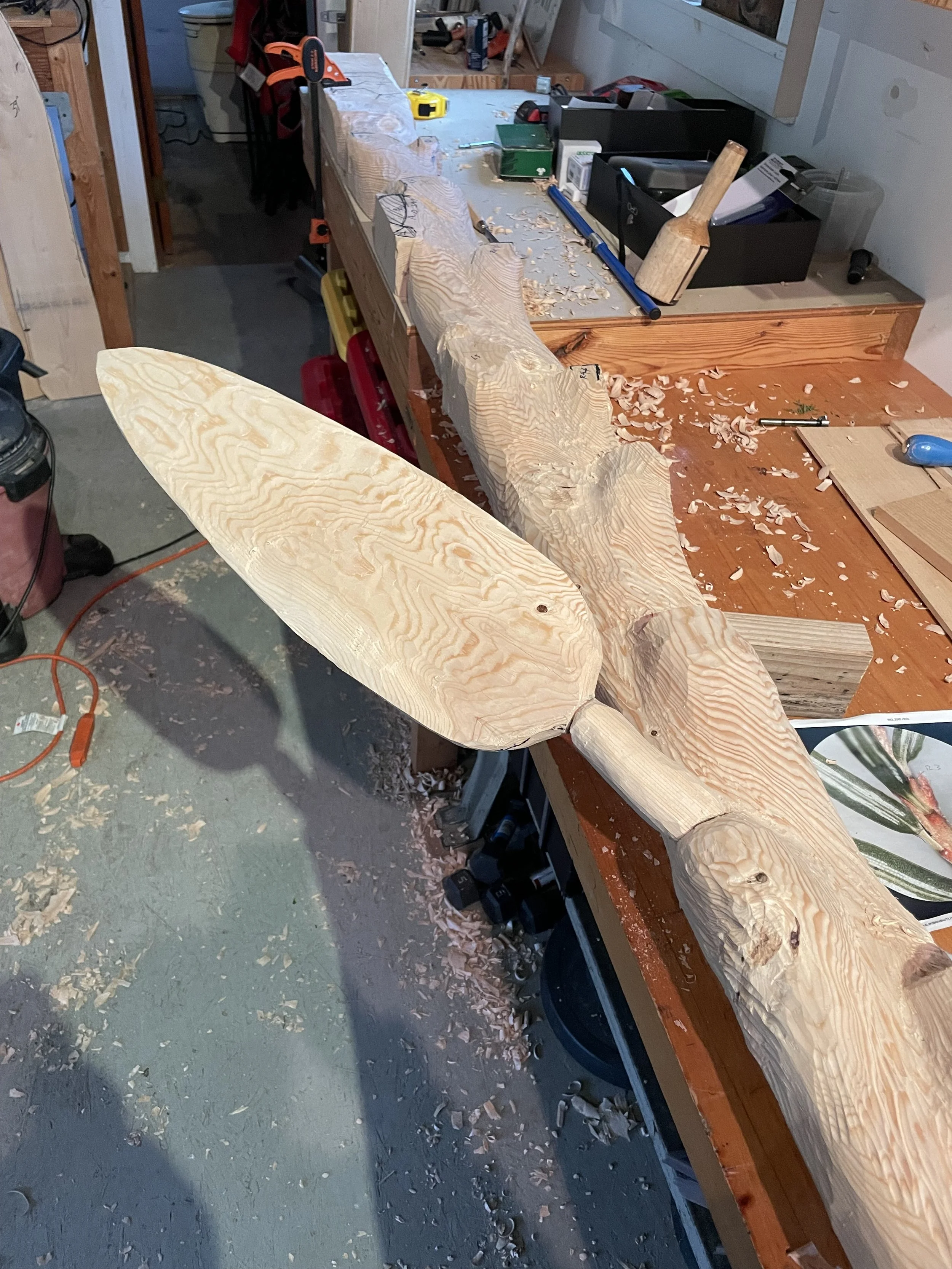
Carving began with two milled beams from a ten-foot segment of the tree. Each has width of six inches and a depth of three.Treating each growth node as a crucial element, material is first reduced in the spaces between them. This work involves handsaws, chisels, and gouges. The bough stem is shaped into a semicircle (it will be mounted flat against the wall). Then, the nodes can be given their particular bulbous shape. Holes are drilled into each node for the insertion of needles, which are shaped using a drawknife on large, thin slabs of hemlock.